We often assume that once we know al-Khwārizmī's name and call him the "father of algebra," there is nothing more to say. But this overlooks how he practised algebra, which was sometimes quite unlike the approach taken by his successors. We may know that he drew on inheritance problems to set up equations, but who has delved into the details to understand how the complexity of these questions might have piqued his curiosity?
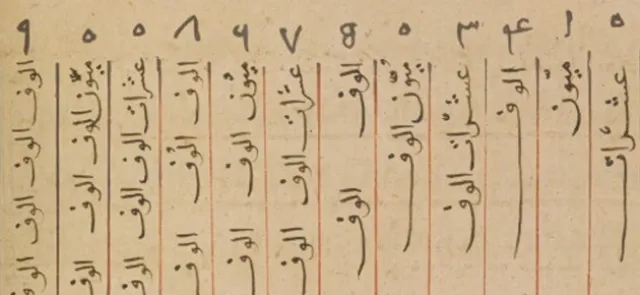
Similarly, we readily speak of "Arabic numerals" without realizing that they originated in India, or that the Islamic world used many competing numeral systems, even after Indian numerals were introduced. Thus, a single paragraph in a manuscript may contain several different numeral systems, without our necessarily being able to understand today why a particular mathematician made that choice.
We also sometimes tend to see Arabic science as no more than a link between Greece and the Latin West: its sole merit, supposedly, was to have preserved texts during the darker periods of the Middle Ages. Translations into Arabic were certainly of great importance, and this work sometimes enabled lost Greek texts to be rediscovered, but it would be wrong to overlook the original advances and innovations made over the centuries.
Exploring the history of mathematics in the Islamic world reveals ingenious methods that reflect remarkable insight and remain entirely relevant, not only for teaching but also for the sheer pleasure of understanding how they work.
From al-Bīrūnī to al-Zanjānī, by way of Abū l-Wāfā’ and Thābit ibn Qurra, this issue brings you eleven articles by researchers who are specialists in their subjects. Their fresh, in-depth perspectives take you beyond the often-rehearsed themes and are ordinarily found only in academic publications, but here they have been made accessible to everyone.
Our warmest thanks go to Marc Moyon for his help in putting together this special issue, the first – but not the last – to focus on a particular geographical or cultural region and thus immerse you in the reality of mathematics as it was conceived and developed elsewhere.