The tragic fate of the discoverer of hospital-acquired diseases
----------------------------------------------------------
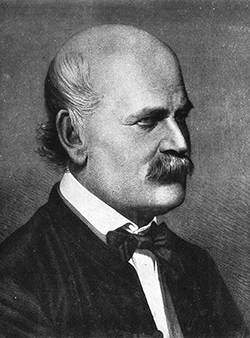
Born in Buda in 1818, the Hungarian Philippe Ignace Semmelweis, a law graduate from Pest (on the other side of the Danube), became an obstetrician in 1846 after attending the autopsy of a woman who had died of puerperal fever.
The Vienna General Hospital had two maternity wards, one taking medical students as trainees and the other midwifery students, with mortality rates of 30% and 10% respectively. In May 1847, after swapping the trainees between the two wards, Semmelweis asserted that "it is the fingers of the students, soiled during recent dissections, that will carry the fatal cadaveric particles into the genital organs of pregnant women". Semmelweis then required every student to wash their hands thoroughly with a chlorinated lime solution after a dissection. The mortality rate fell to 12%.
But after examining a woman with uterine cancer and then, without washing his hands, examining five pregnant women who died shortly afterward of puerperal fever, he realized that the cause was not solely cadaveric, but that "hands, through mere contact, can be infectious". From then on, the hands and instruments of every practitioner had to be disinfected, and mortality fell to the level of today's best maternity wards.