In the summer of 1665, a plague epidemic ravaged England: 68,596 deaths were recorded in London, representing between 15 and 20% of the population. The disaster had two fortunate consequences for the history of science. Cambridge University sent its students home, and one of them spent his time walking, daydreaming and filling pages with figures. "I am ashamed to admit how many decimal places I carried these calculations to when I had the leisure. Truly, at that time, I took too much pleasure in this research." He was 22 and in the process of inventing modern calculus and physics: his name was Isaac Newton. The other beneficial consequence was due to one John Graunt (1620–1674), a draper by trade and, according to a friend, a "pleasant and facetious companion". He took it upon himself to analyse the information reported in the "bills of mortality" published in London during successive plague epidemics. The outbreak of 1665 was by no means the first: there had been epidemics in 1592 (11,503 deaths), 1603 (30,561 deaths), 1625 (35,417 deaths) and 1636 (10,460 deaths). Records had been kept, but before Graunt no one had thought of using them to make numerical predictions: this marked the birth of statistics as applied to demography.
The first life table
------------------------------
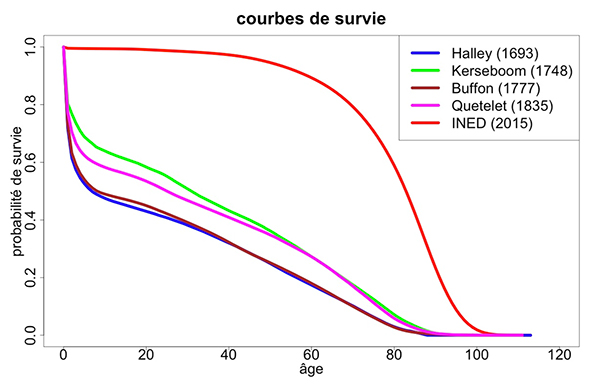
Graunt's Observations on the Bills of Mortality contains the first life table in history. "Of one hundred children, he wrote, 36 die within the first six years and 24 over the following ten." An astonishing 60% of newborns did not reach the age of 16! Plague did not account for everything: this had always been the case, and the situation changed little until the mid-19th century. The following curves show the percentage of newborns surviving to each age. The red curve represents data for France in 2015, where infant mortality was well below 1%. In centuries past, mortality was around 20% by the age of one and 50% by the age of eight. Who deserves credit for this victory? Medicine, and the standards of hygiene it succeeded in establishing throughout society. Yet physicians had existed everywhere since antiquity. Why did it take until the 19th century for their work to become so effective on such a large scale? At least part of the answer lies in the simultaneous development of statistics.
Calculations of life expectancy and collections of demographic or economic data dated back at least to the 17th century. During the first half of the 19th, however, a new phenomenon emerged: the "avalanche of numbers" (see Mathématiques et médecine (Mathematics and Medicine), Bibliothèque Tangente 58, 2016 and Mathématiques des assurances (The Mathematics of Insurance), Bibliothèque Tangente 57, 2016). In every field, people began compiling data and trying to extract information from it. Within a few generations, medicine moved from case descriptions to tables of figures. Three medical triumphs illustrate the role statistics played in its early days.