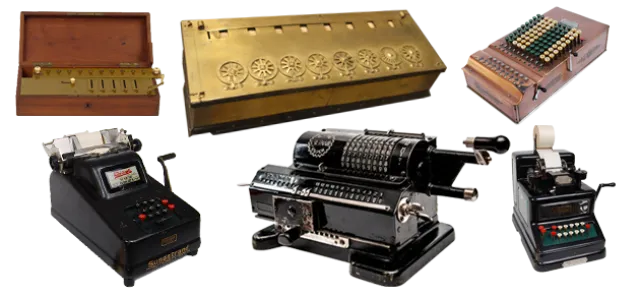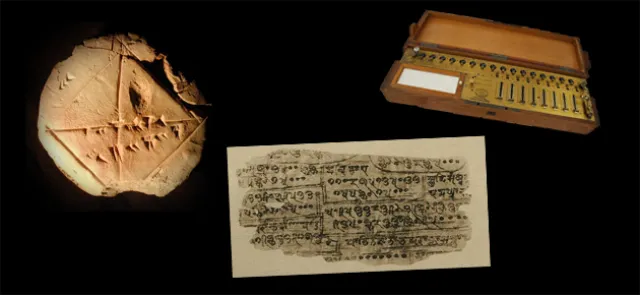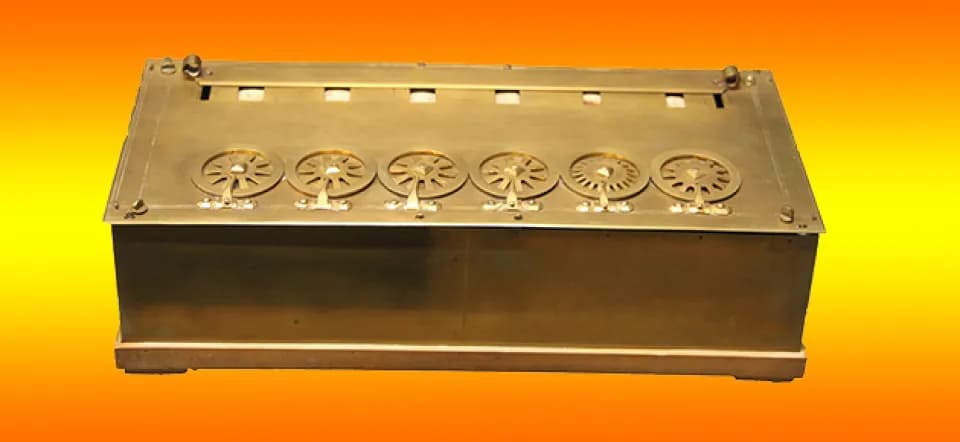
Usually faster than calculating "by hand," mechanical calculation was the first means of escaping slow, repetitive tasks. The invention of logarithm tables and the slide rule in the early 17th century had already made calculation easier, but it was above all the advent of electronic calculators and computers that brought about the demise of mechanical calculators, some of which remained in widespread use until 1970. They are museum pieces today, yet their technical sophistication, their inventors' ingenuity and their users' skill still inspire admiration.
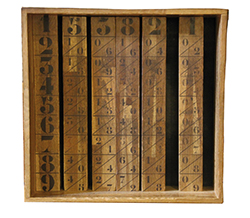
From pebbles to arithmetic machines
------------------------------------
As early as prehistoric times, people had the idea of representing numbers with tangible objects or visible symbols: counting on one's fingers was common practice, while making notches in bones or using counting pebbles (calculi in Latin, from which our word "calculation" derives) and combining two collections of them to add the quantities were ways of recording numbers and using them, at least for addition. From the 4th century BCE onward, calculation tables known as abacuses came into use. Evolving from "marks in the sand" to "counters in columns," they were, in a sense, the ancestors of our computer spreadsheets.
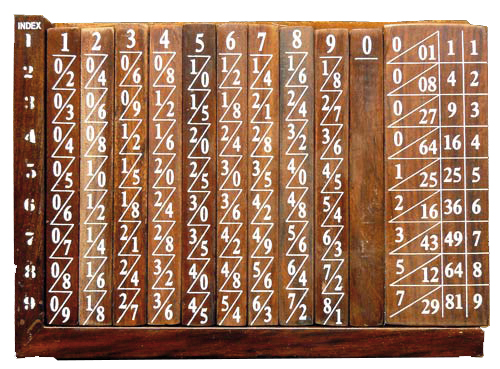
Calculation with counters evolved into the abacus, already used by the Romans. Whether Chinese, like the suan pan (12th century), or Japanese, like the soroban, abacuses come in many varieties and are sometimes still used today—for example, by market traders in Japan. An abacus can perform multiplication as well as addition, but in 1617 Napier, the inventor of logarithms, also arranged numbers in columns on his famous rods, inspired by the multiplication table, to multiply quickly and accurately.