In a football match, the outcome is clear: a win, a loss or a draw. Predicting that outcome before the match, however, is anything but straightforward. There is simply no magic formula! Football is played by humans, and human nature is very difficult to predict. Nevertheless, we can use mathematics to try to come as close as possible to such a formula. The idea is to model the outcome of a match using a probability distribution—that is, a mathematical formula intended to describe the outcome of a random event.
The bivariate Poisson distribution
A football match pits two teams against each other, each of which may score a certain number of goals within a fixed period of time (ninety minutes, plus stoppage time). A natural way to describe a random phenomenon X that can occur several times within a fixed time interval is the Poisson distribution, with the formula P(X = k) = exp(‒λ) × λ*k/k! for evaluating the probability that X takes the value k. Here, the integer k ≥ 0 is the outcome of X, while the parameter λ ≥ 0 is the expected value of X. A slightly more complicated version, called the bivariate Poisson distribution* and accounting for the interaction between the two teams, can be used to model the outcome of a football match. This is the version that interests us here.
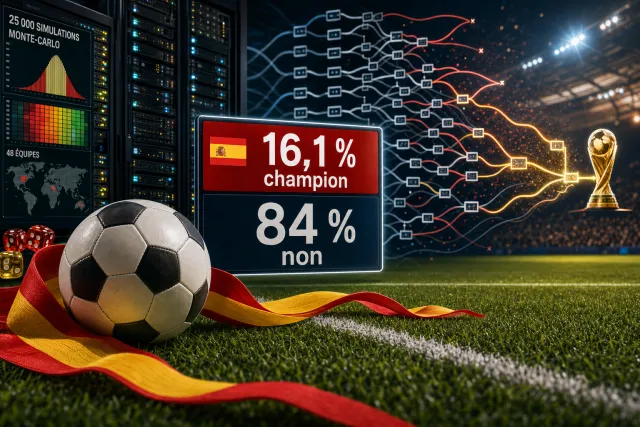
In late 2022, the twenty-second FIFA World Cup was held in Qatar. It was a major occasion for football fans, and the big question was: who would become world champion? Fans often organized prediction contests among themselves, while the sports-betting industry also reaped the rewards (see our feature "Les paris", Tangente 136, 2010). Let's see how a mathematical model combined with artificial intelligence (AI), along with the necessary dose of statistics and machine-learning techniques, can help predict the winner.
To do so, we will describe a model used for the 2018 men's World Cup and the 2019 Women's World Cup (the 2022 men's World Cup was too unusual to allow scientifically valid predictions; see below). We will focus on the first of these.