Cycling, bridge… using probability to diagnose cheating
----------------------------------------------------------------
The world of sport is not immune to cheating, as everyone knows. Mathematics, and probability in particular, can help detect it. For instance, "improbable" results first raised suspicions of doping against the man then considered the best cyclist in the world, the American Lance Armstrong — suspicions later confirmed.
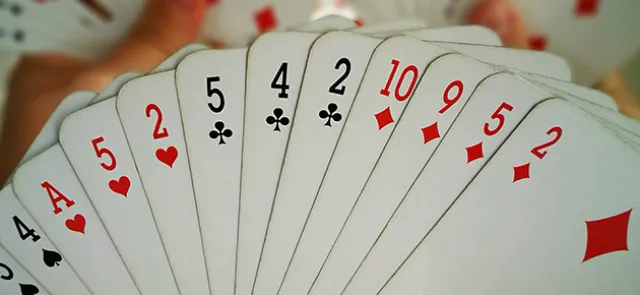
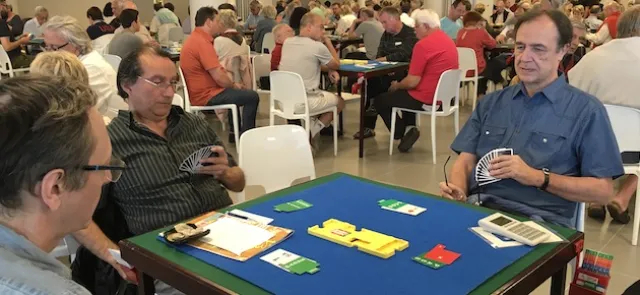
Bridge, which in this context can be likened to a sport (it is a sport of the mind), has likewise just been through a number of shocking episodes. The world's top two players, the Italians Fulvio Fantoni and Claudio Nunes, have just been found guilty of cheating, not long after the Israelis Lotan Fisher and Ron Schwarz. For both pairs, the same pattern emerged: suspicion arose from ways of playing (or leading, that is, placing the first card of a hand on the table) that ran contrary to probability.
Bridge is a game with incomplete information. Two of the four players' hands are unknown, and the choices made are based on maximizing the expected value of the winnings. When a mediocre player fails to adopt the optimal strategy, the lapse can always be put down to inexperience. But when a champion follows a poor strategy that turns out to be winning because the cards happen to be distributed in an unlikely way, questions can be asked. For the players in question, this situation occurred often enough to raise a suspicion: that of communicating with their partner illicitly ("meaningful" coughing fits, orientation of cards according to a binary code…). This was confirmed by numerous studies of recorded games from competitions.
-
Maths week on the theme of "Maths and Sport"
----------------------------------------------------
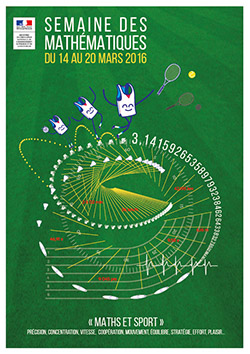
Every spring, a "maths week" is scheduled in schools by the Ministry of Education. Designed to raise students' awareness of the cultural side of mathematics and to show its role in the scientific understanding of the world, it is increasingly open to the general public each year. The week begins on ?-day (yes, March 14, 3/14 in English notation) and will be filled with all sorts of activities built around the theme that inspired this issue of Tangente: "Maths and Sport". Mathematical competitions (IREM regional rallies), lectures across every académie, from primary school to the final year of high school, rounds of the "Kangaroo competition", theatrical performances ("L'affaire 3,14" will be staged in Grenoble by the company L'île Logique), a Sophie Germain day on March 18 in Paris (at the Institut Henri Poincaré, see page 40)…
-
Mathematics and sport: a special issue more useful than ever
-------------------------------------------------------------
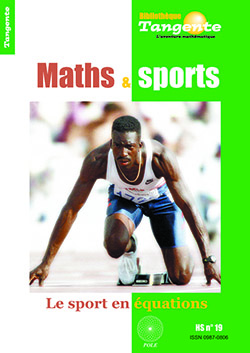
Special issue number 19 of Tangente, published ten years ago now, was already devoted to the theme "Maths and Sport". Like all special issues, it comes in two versions ("newsstand" and "Library"), and it is still available in both formats (see page 4).
After a historical feature (from the Greeks to Alan Turing), things get serious.
• "Organizing and ranking": organizing championships, putting together a team, the absurdity of certain systems such as the three-point win, and taking transitivity into account in the individual ranking of a discipline…
• "Strategy and tactics": the use of game theory in tennis or squash, but also in the LotoFoot!
• "Sporting techniques", with a strong focus on the geometry of trajectories and equipment (rackets, balls,…).
• "Measuring and predicting": this time probability takes center stage, but this feature also raises questions about concrete measurement (of lengths, of time) and the physical translation of the concept of limit.