Strong serve, weak serve
----------------------------
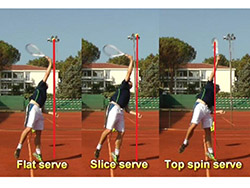
#### The three main types of serve: the flat serve (the racket strikes the ball forward with no spin), the slice serve (with slice, which gives the ball a sideways spin), and the topspin serve (with topspin: the ball is struck from low to high, with spin directed upward).
In tennis, for a serve (the initial throw of the ball) to be valid, the ball must land in a specific area, the service box (which is actually a rectangle). A player has two chances to make a valid serve: if the first serve is missed, a second attempt is allowed (the second serve). If that also fails, the server loses the point (this is called a double fault).
A player generally uses two types of serve: a strong one and a weak one. The ball can be struck with power (a flat serve), on a straight trajectory (champions serve at more than 200 km/h), or served more gently, with spin (slice or topspin) giving it a parabolic path. This increases the success rate.
When a serve lands in the opponent's service box (the ball is called in), this is denoted by SF if the serve is strong or Sf if it is weak. Otherwise, when the ball is out, this is denoted (or ). With G denoting a point played on serve and won by the server, the probabilities P(SF) and P(G | SF) — the probability that the server wins the point after a strong serve — are assumed to be known and constant (and likewise for Sf).
The server can therefore choose between four strategies: SF–Sf, SF–SF, Sf–Sf, Sf–SF.
The assumptions are: P(G | SF) ≥ P(G | Sf) and P(Sf) ≥ P(SF). Probability theory already shows that the fourth strategy, less effective than the first, will never be used. The calculations show that the player may be led to choose the second strategy (when they fear a winning return from their opponent or want to surprise them), or the third (when they want to be sure of getting their first serve in).
-
The 2015 Davis Cup final
--------------------------------