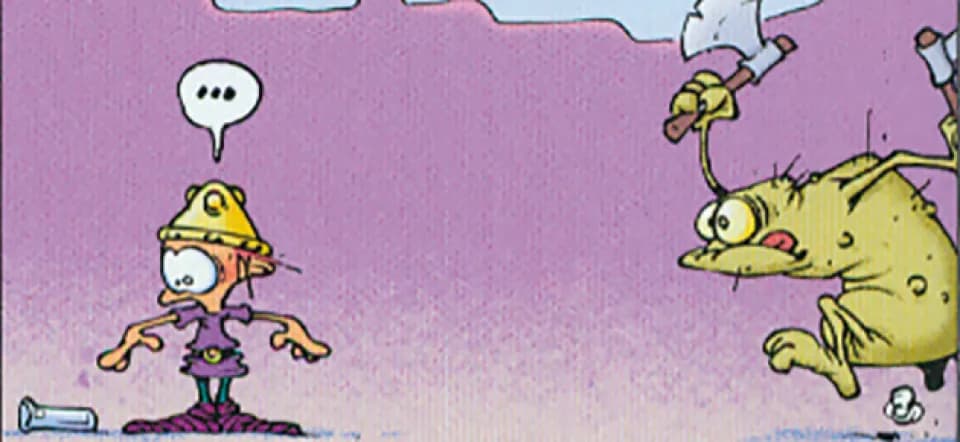
Readers first encountered Midam’s characters in the pages of Spirou magazine in the early 1990s, in interconnected worlds poised between fantasy and computer-generated reality, between a passion for video games and genuine nightmares. In those pages and the many albums that followed, we encounter the family and friends of Kid Paddle, a little boy much like any other with a passion for video games, alongside a companion series (a spin-off) chronicling the misadventures of his virtual double, the Little Barbarian. The latter, "Game Over", whose title promises an inevitable end to the game, is particularly rich in conceptual subtext. Let's explore this strange world in the dazzling light of the art of mathematical modelling.
From observations to a general law
-----------------------------------
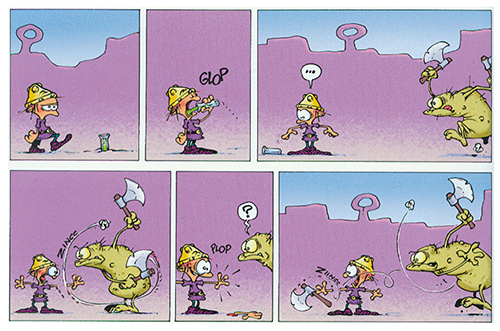
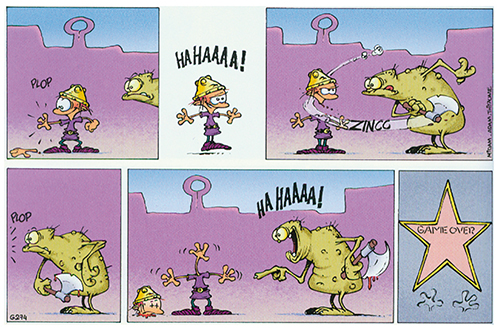
Building a model means trying to establish a general law from observations of particular cases. This is inductive reasoning. As long as the observations agree with the model, we retain it. But a single contradictory observation is enough to invalidate it. Consider the Little Barbarian grappling with a hideous Blork who wields an axe with great skill and chops off first his left arm, then his right. The horror would be complete had our hero not previously drunk a miraculous potion with magnificent regenerative powers: every severed limb instantly grows back. These observations suggest a model: thanks to the magic potion, anything that is cut off regenerates. This model is based on only a limited number of experiments. Will subsequent experiments confirm it? The rest of the adventure provides the answer. The aggressive Blork goes so far as to chop off the unfortunate Barbarian’s head. Then comes the surprise: while the head now lies forlornly beside him, a hand appears in its place and, as before, waves helplessly, much to the Blork’s delight. The experiment has invalidated the first model. We must propose a new one, every bit as provisional as its predecessor. Thanks to the magic potion, anything that is cut off regenerates in the form of an arm and a hand.