Imagine an individual—the decision-maker—who must choose among several possible options in a finite set A. The elements of A might be products, people, social categories, marketing strategies…
The decision-maker uses a single, clearly defined criterion (such as price or quantity when the actions are purchased goods, or a physical or psychological quality when they are people…). With respect to this criterion, for every pair (a, b) of elements of A, the decision-maker can make one and only one of the following judgments:
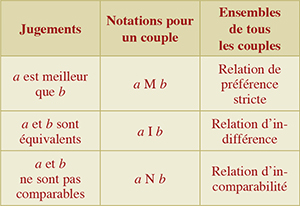
In keeping with intuition, M is generally assumed to be transitive (if a is better than b, and b is better than c, then a is better than c), I to be reflexive (a is equivalent to a) and symmetric (if a is equivalent to b, then b is equivalent to a), and N to be symmetric. Moreover, M, I, and N are pairwise disjoint. Subject to further technical assumptions, the triple (M, I, N) then defines a preference structure on A. The union of the relations M and I alone defines a preference relation.
The joys of collective decision-making
---------------------------------------