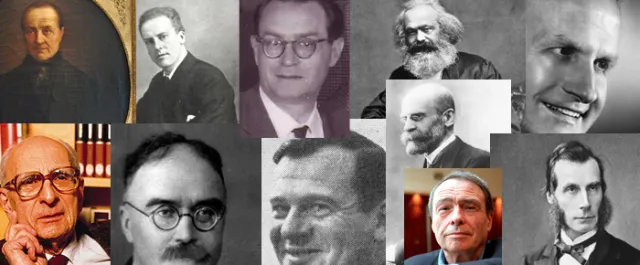
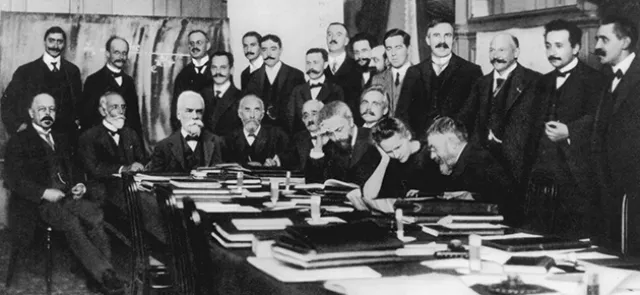
Halbwachs and Fréchet: the benefits of a shared course
--------------------------------------------------------
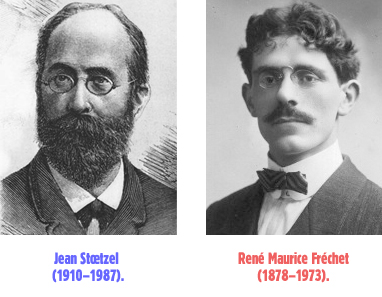
In 1919, in the aftermath of the First World War, the French government was eager to make the reconquered territories of Alsace and Lorraine French again. The aim was to turn them into a showcase for France; accordingly, leading figures from French universities, preferably German speakers, were appointed there. Among them were the sociologist Maurice Halbwachs and the mathematician Maurice Fréchet, who would go on to teach a joint course at the Institut commercial d'enseignement supérieur de Strasbourg. This course dealt with the applications of statistics to social phenomena.
Strasbourg's interest in statistics is a legacy of the German period, when the city's university was a hub of research in economics and statistics, notably with Georg Friedrich Knapp. Isn't this idea of a joint course, taught by a mathematician and a sociologist, the best way to teach statistics to sociologists?
Jean-Paul Benzécri: applying data analysis
------------------------------------------
After studying at the École normale supérieure on rue d'Ulm, Jean-Paul Benzécri (born in 1932) defended his thesis on affine varieties under the supervision of Henri Cartan. He then turned resolutely to statistics, which he taught until his retirement at the Université Pierre-et-Marie-Curie and at the Institut de statistiques de l'université de Paris. More specifically, he worked on data analysis. His key contribution was the introduction of correspondence analysis, which makes it possible to determine and rank the dependencies between the rows and columns of a matrix.
Correspondence analysis has been widely used in the humanities and social sciences, particularly in linguistics by Benzécri himself. It has also been used in history by Antoine Prost and, of course, in sociology by Pierre Bourdieu.
Paul Lazarsfeld: the impact of the media on voters
--------------------------------------------------
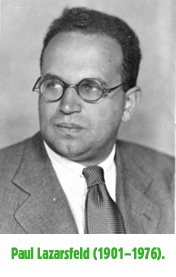
The American sociologist Paul Lazarsfeld, of Austrian origin, was born in Vienna. In his home city, he earned a doctorate in applied mathematics in 1925. His socialist convictions drove him to put his mathematical knowledge to work in research on social psychology, and that same year he founded a research institute devoted to this field.
Invited by the Rockefeller Foundation, he came to the United States in 1933. Faced with the rise of Nazism, he chose to stay there and went on to direct a research center located in Princeton, New Jersey, which was transferred in 1940 to Columbia University in New York, where he soon obtained a position.
His American work focused above all on the impact of the media on voters. He concluded that this impact is minimal in direct terms but that the media shape the thinking of politicians, resulting in an indirect influence on citizens.
He developed new methods for collecting and analyzing data. He consistently sought to base sociological analyses on statistics and clarified the logical frameworks that allow conclusions to be drawn.
His influence is considerable, both in the United States and in Europe. In France, his ideas—but above all the methodology he established—were disseminated by Jean Stoezel and Raymond Boudon; the latter published L'Analyse mathématique des faits sociaux in 1972 (Plon, 1967).