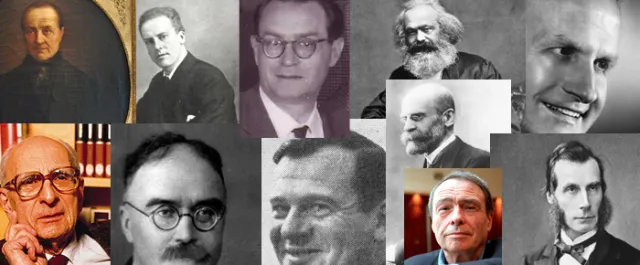
There is a paradox here: correspondence analysis was created by Jean-Paul Benzécri, a mathematician whose philosophical convictions led him to challenge the practice of the social sciences, which he believed had been corrupted by left-wing political positions in the 1970s. Yet the method's most effective advocate was Pierre Bourdieu, who stood at the opposite end of the political spectrum from Benzécri. Benzécri devised his method precisely to allow data to be examined without a priori assumptions, replacing common sense—and researchers' political leanings—with statistically defined factors whose neutrality and explanatory power make them compelling.
Such a method naturally appealed to research institutions such as the Institut national de la statistique et des études économiques (Insee), whose remit included producing politically neutral analyses of official data. Several of Benzécri's students would bring his method to Insee and become its advocates there. One of them, Alain Darbel, had met Pierre Bourdieu in Algeria. He worked with Bourdieu on a survey of art and museums and introduced him to the method's value. Bourdieu's books and the journal he founded, Actes de la recherche en sciences sociales, contain numerous correspondence analyses—and still do today.
The Brel–Brassens–Ferré trio
---------------------------
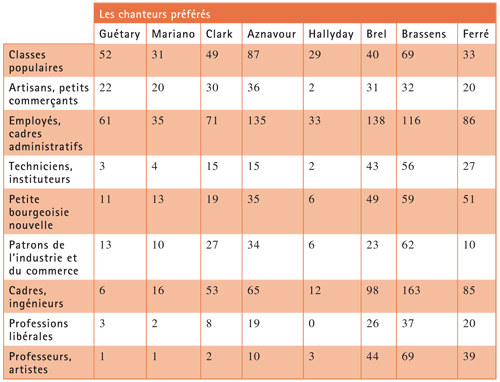
To understand correspondence analysis, let us take an example drawn from the data in Bourdieu's celebrated book La Distinction (Éditions de Minuit, 1979). In a survey covering a wide range of tastes in fields such as painting, music and reading, respondents were asked whether each of the following singers from the 1960s was among their favorites: Georges Guétary, Luis Mariano, Petula Clark, Charles Aznavour, Johnny Hallyday, Jacques Brel, Georges Brassens and Léo Ferré. The table below shows how many respondents in each social category said that a given singer was among their favorites; respondents could name more than one. The sizes of these categories ranged from 52 for the liberal professions to 287 for employees and middle managers.