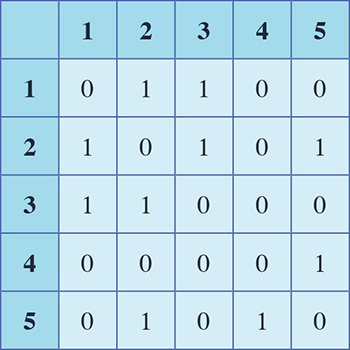
Who has never heard of social networks? In France, the term encompasses technological and digital communication platforms (Facebook, Twitter, and so on), but these do not cover its full sociological scope. Let's take a step back and return to the broader meaning: a system formed by links between people. Mathematicians can represent these objects in two ways: as graphs or as matrices. In the first, individuals are modeled as points (vertices) and links as arrows (arcs) or undirected lines (edges), forming a graph. Alternatively, we can choose the dual representation, in which individuals are represented by the rows and columns of a matrix: two interacting individuals i and j give an entry of 1 at the intersection of row i and column j (and at the intersection of column i and row j), and an entry of 0 otherwise. This gives an adjacency matrix.
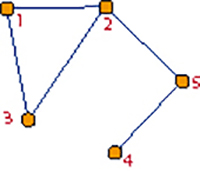
An example of a social network represented as a graph…