
In tropical and subtropical regions, some diseases are transmitted by mosquitoes, including malaria, yellow fever, dengue and chikungunya. The last of these once made headlines on Réunion Island; it is caused by the tiger mosquito Aedes, which transmits a virus in its saliva when it bites. An infected person develops a fever, muscle pain and skin irritation, generally for a few days but sometimes for several months. There is no preventive treatment for this infection, but a patient's body naturally produces antibodies, generally allowing them to become immune and resistant to the disease. This raises the question of how to assess the true short- and long-term effects of a treatment campaign in a region afflicted by such a scourge.
-
Determining a transition matrix
--------------------------------------------
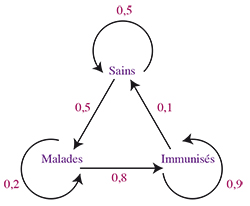
Consider a country where a disease spread by mosquito bites is prevalent. Its population can be divided into one (and only one) of the following three categories: