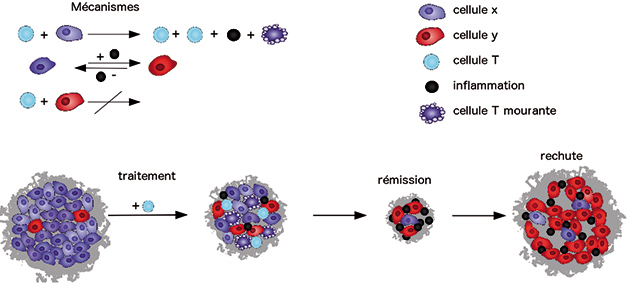
Melanomas, a type of skin cancer, can be treated with targeted therapy. Certain immune-system cells, known as T cells, can recognize these cancer cells by markers on their surface and eliminate them. However, with immunotherapy treatments in which T cells are injected into human patients or mice, inflammation is observed, to which the cancer cells respond by losing these markers. This makes them resistant to attack by T cells, which can no longer recognize them. After a period of remission, the cancer relapses: the tumour begins to grow again.
------------------------------
A mathematical model based on an experiment in mice
-----------------------------------------------------------------
A study in mice conducted by researchers at the Clinique Universitaire de Bonn shows that markers are also lost without treatment, though at a very low rate, and that this loss is greatly increased by the presence of the protein responsible for inflammation, which is produced when a T cell kills a cancer cell.