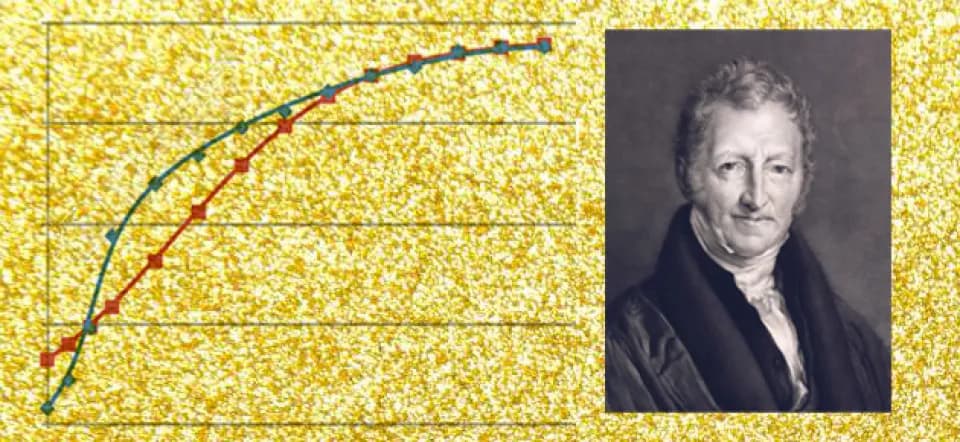
Logistic functions arose from the desire to find mathematical models that could predict how a country's population would change over time. These questions, which obviously interested demographers and policymakers, became a genuine subject of research, after some tentative beginnings, at the dawn of the 19th century.
Population dynamics
-------------------------
The mathematical analysis of populations truly began with the German pastor Johann Peter Süssmilch (1707-1767), who noticed statistical regularities in the births, deaths and marriages of his parish. But Süssmilch was not a mathematician and could not go beyond fairly simple statistical remarks. Leonhard Euler (1707-1783), however, proposed far more powerful models in his Recherches générales sur la mortalité et la multiplication du genre humain (General Investigations into the Mortality and Multiplication of the Human Race), which he published in French in 1767. He relied in particular on what is now known as Euler's method, a numerical procedure for approximating the solutions of first-order differential equations with an initial condition.
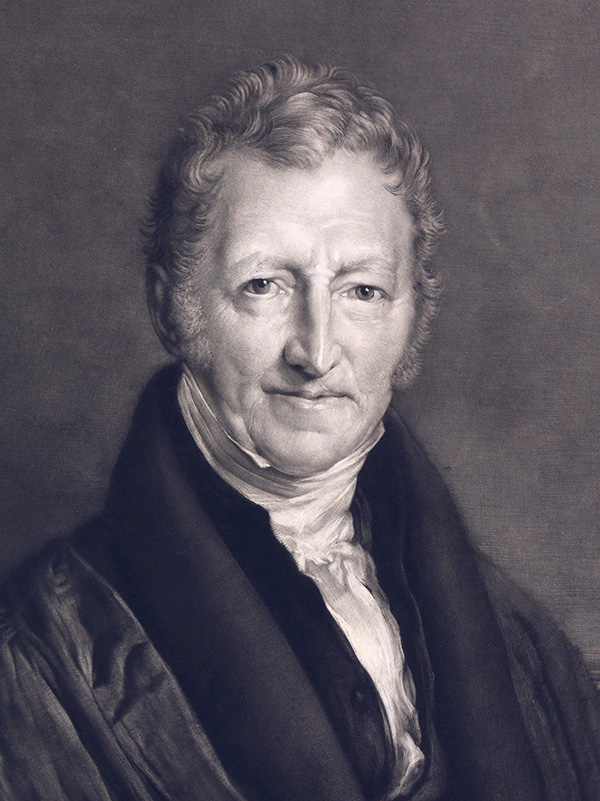
Thirty years later, the economist Thomas Robert Malthus (1766-1834) took up Euler's work and stated, in the very first pages of his Essai sur le principe de population (Essay on the Principle of Population, 1798): "I say that the power of population is infinitely greater than the power of the earth to produce subsistence for man. […] If unchecked, population increases in a geometrical progression. Subsistence increases only in an arithmetical progression. […] The effects of these two unequal powers must be kept in equilibrium by means of this law of nature which makes food a vital necessity for man."