The leopard seal is the main predator of penguins.
####

The gentoo penguin is preyed upon by the leopard seal.
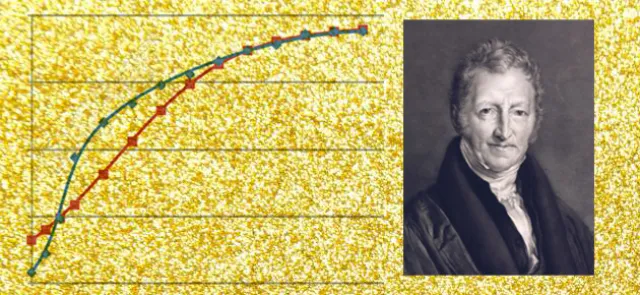
One of the major challenges in managing our planet's resources is forecasting. To have scientific value, a forecast must be based on a model of reality. One of the oldest is that of the British economist Thomas Malthus (1766–1834). Far removed from the negative image now conveyed by the expression "Malthusian policy," Malthus believed that, within any given territory, a population changed according to an exponential model: the population in each year was that of the previous year multiplied by a certain rate (greater or less than 1). In the absence of migration, this meant applying a fertility rate per woman and a mortality rate. It follows that if the birth rate is strictly greater than the mortality rate, the population quickly becomes too large for its territory: if the ratio k of the two rates is strictly greater than 1, then kn tends to infinity as n increases.
If the mortality rate is strictly greater than the birth rate, the population dies out because kn tends to 0 as n tends to infinity when k < 1.