The forty-three authors who entered the problem-writing competition (each entrant was allowed to submit only one problem) displayed remarkable inventiveness. The jury members deliberated at length, but a choice had to be made! They often reached a consensus on the strength of the presentation and the clarity of the solution, but some had fallen for a problem that did not make the final selection. This article offers an opportunity to showcase a few of those problems. You can find the solutions, sometimes improved by the jury members, by clicking on the question.
Pierre-Jean Laurent selected "an interesting little modeling problem that calls for a correct interpretation of the statement. Everything is clear: both the statement and the solution, which is brief but perfect. I therefore recommend it".
Here, then, is Pierre Lemaire's problem.
A walk on the beach
----------------------
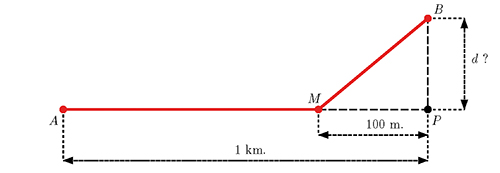
Opposite the lifeguard station is a buoy, which gives me a reason for my daily exercise. I always set out from point A, exactly 1 km from lifeguard station P. I walk along the water for a while, always at 3 km/h, then swim to buoy B, always at 2 km/h. I have noticed that the total duration of my exercise is shortest when I enter the water 100 m from the lifeguard station.
Élisabeth Busser selected an arithmetic problem "that can be stated in very few words and solved without too much difficulty or computation". She also shortened the solution by Arnaud de Ferry, a retired engineer with a passion for mathematics, who devised the problem based on Kaprekar numbers. Here is the problem.
How old am I?
------------------
My wife is three years older than I am. I still think we are young! Yet if I add the square of her age to the square of mine, I obtain a four-digit number whose digits add up to 8.
Philippe Fondanaiche, who runs the website **diophante.fr*, selected "a classic exercise in logic that calls for deductive reasoning". Why did he choose it? He regards this method of problem-solving as fundamental and is concerned that it is being increasingly sidelined in high schools and middle schools. He is indignant that learning mathematics should be reduced to "blindly"* applying ready-made recipes or using formulas without understanding what they mean, an approach he considers increasingly fashionable in education.
Here, then, is his favorite problem, devised by Marie-Pierre Falissard, one of the few women who entered the competition.
Some very unusual friends
--------------------------
My eight logician friends know one another well. Some lie all the time; the others never do. One day they tell me:
Abel: "I don't like Boole, and Frege is lying!"
Boole: "Abel is my best friend."
Cantor: "I've moved house, and Boole is lying!"
Dedekind: "You are my best friend, and Cantor has moved house."
Erdös: "Dedekind hates you!"
Frege: "Erdös isn't lying."
Gödel: "I don't lie, but Frege and Hardy do."
Hardy: "Half your friends lie; the other half don't."
Raymond Bloch, meanwhile, chose not only to select but also to develop further (see box) a problem submitted by Thierry Falissard, an ENPC engineer with a passion for chess and mathematics. The problem is, of course, about placing chess pieces on a chessboard. Raymond Bloch: "Searching for solutions to this broad family of problems opens the way to investigations and discoveries requiring ingenuity, tenacity and rigor, but no mathematical formulas… It also teaches us the caution needed when faced with a proof that seems unassailable but turns out to be false. I hope that readers of Tangente will share this puzzle with their families and friends, to show them the pleasure of searching for—and sometimes finding—an apparently impossible solution. And congratulations to the author of this problem."
Queens under attack
------------------
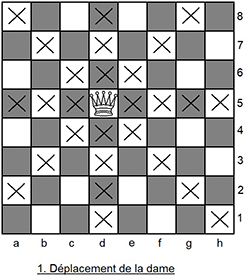
In chess, the queen (Q) moves vertically, horizontally and diagonally across any number of squares (see figure). It can capture an opposing piece on a square it attacks by taking its place.