For several decades now, a series of shows have been created whose aim is to use theatre as a medium for bringing mathematics to young people—and those not so young. This is mathematics cooked up with a theatrical twist. Sometimes it is theatre. It is always mathematics! But what about "real" theatre, whose aim is to make audiences love theatre? Might it sometimes contain mathematical elements without even knowing it?
The answer is yes, as examples from French theatre will show. And French theatre immediately brings us to its greatest and most universal playwright: Molière (1622–1673). To paraphrase the Académie française member Bernard-Joseph Saurin (1706–1781), who lamented the great man's absence from the Académie: "Nothing is lacking from his glory; he was lacking from ours." For there is mathematics in Molière! Mathematics from the 17th century, of course, but real mathematics (see Tangente 163, 2015).
Different monetary systems
------------------------------
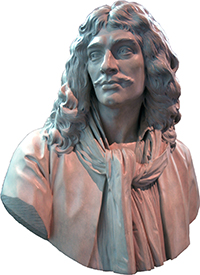
Since the great Jean-Baptiste Poquelin set out to portray every failing of the human soul, his characters naturally refer to money quite often. And where there is hard cash—and money was very tangible in those days—there is borrowing, and hence usury. We might therefore expect a parade of the finest scenes from L’Avare (1668). Fine examples of financial arithmetic certainly abound there (see Tangente 203, 2021), whether Harpagon is scolding his overdressed son (Act I, Scene 4) or the latter is unwittingly borrowing money from his father (Act II, Scene 1). But these are far from the only examples! In Le Bourgeois gentilhomme (1670), the Marquis Dorante calculates the total amount lent to him by Mr Jourdain (Act III, Scene 4), giving us some splendid exercises in addition and subtraction using non-decimal currency! Other examples also occur in Act II, Scene 7 of Les Fourberies de Scapin (1671). But what mathematics can we draw from them? The financial system of the time used a great many monetary units—deniers, sous, francs, livres, écus, louis and pistoles—with no decimal relationship between any two of these seven currencies! Starting from Molière's dialogue and denoting the different monetary units by x1, x2… x7, we find that parts of the dialogue can be expressed as linear relations among all these variables. We can construct a system of homogeneous equations whose solution gives the ratios between the different currencies.