



Depuis quelques décennies, une série de spectacles ont vu le jour qui ont pour objectif d’utiliser le théâtre en tant que medium pour faire passer les maths auprès des jeunes (et des moins jeunes). On a affaire là à des maths cuisinées à la sauce théâtrale. C’est parfois du théâtre. C’est toujours des maths ! Qu’en est-il alors du « vrai » théâtre, celui qui a pour objectif de faire aimer le théâtre ? Ce dernier contient-il parfois, sans le savoir, des éléments de mathématiques ?
La réponse est positive et la monstration va en être donnée à partir du théâtre français. Et qui dit théâtre français nous porte immédiatement à parler du plus grand, du plus universel des auteurs, c’est-à-dire Molière (1622–1673). Pour paraphraser l’académicien Bernard-Joseph Saurin (1706–1781), déplorant l’absence du grand homme sous la coupole : « Rien ne manque à sa gloire, il manquait à la nôtre. » Car il y a des maths dans Molière ! Des maths du XVIIe siècle, évidemment, mais de vraies mathématiques (voir Tangente 163, 2015).
Différents systèmes monétaires
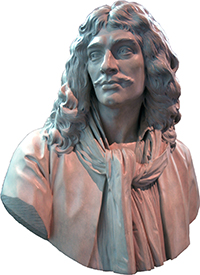
Comme le grand Jean-Baptiste Poquelin avait pour but de décrire l’âme humaine dans tous ses travers, ses répliques font évidemment souvent référence à l’argent. Et qui dit espèces sonnantes et trébuchantes (à l’époque l’argent était très matériel) dit aussi emprunt, et donc usure. On s’attend donc ici à voir défiler les plus belles scènes de L’Avare (1668). Il est vrai que de beaux exemples d’arithmétique financière y fleurissent (voir Tangente 203, 2021), quand Harpagon tance son fils trop bien habillé (Acte I, scène 4) ou quand ce dernier emprunte sans le savoir de l’argent à son père (Acte II, scène 1). Mais ce ne sont pas les seuls exemples que l’on puisse citer, loin de là ! Ainsi, dans Le Bourgeois gentilhomme (1670), le marquis Dorante calcule le total des sommes à lui prêtées par Monsieur Jourdain (Acte III, scène 4) pour nous offrir de très beaux exercices d’additions et de soustractions en arithmétique non décimale ! D’autres exemples apparaissent aussi, Acte II, scène 7, dans Les Fourberies de Scapin (1671). Mais quelles mathématiques en tirer ? Le système financier de l’époque comportait un grand nombre d’unités monétaires (les deniers, les sous, les francs, les livres, les écus, les louis et les pistoles, sans qu’aucun rapport de décimalité n’existât entre deux quelconques de ces sept monnaies !). En partant des répliques de Molière, et en notant x1, x2… x7 les différentes unités monétaires, on constate que des éléments de dialogue peuvent se traduire sous la forme de relations linéaires entre toutes ces variables. Un système d’équations homogènes peut être construit, dont la solution fournit les rapports entre les différentes monnaies.