It was a historian of astronomy, Mathieu Ossendrijver (Humboldt University, Berlin), who has just discovered this in photographs of Babylonian tablets. They had been left to him by his colleague Hermann Hunger (University of Vienna), and one of them referred to a method for calculating areas using trapezoids, like the tablets from the period between 350 and 50 BCE that he had already studied.
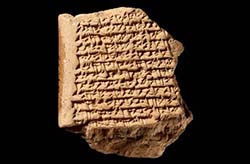
The researcher was certain: these tablets dealt with the planet Jupiter, and the new tablet proved him right, since it is the one that describes the algorithm used in the others. From this, the distance travelled by the planet along the ecliptic can be determined using its angular velocity, which they assumed varied linearly with time. In the Babylonian calculations (for which no diagrams have ever been found), everything therefore works as though the curve showing how the velocity varied had been plotted, and the area beneath it calculated by dividing it into trapezoids. This is the method known as "the Oxford Calculators" (14th century), also used in the same period by the Frenchman Nicole Oresme, and which is nothing other than our integral calculus — but for these tablets, it is "the oldest example of a link between geometric reasoning and mathematical astronomy," states Jim Ritter (Institut mathématique de Jussieu).