In Book I of the Elements, Euclid defines a line as a length without breadth and a surface as having length and breadth only. In Book XI, he adds solids, which have length, breadth and depth. Today, we interpret these as dimensions 1, 2 and 3. With Descartes's analytic geometry, whose beginnings can be found in Apollonius's work on Conics, each point is specified by one number on a line, two on a surface and three in a solid; the notion of dimension becomes more precise: it is the number of parameters needed to specify a point. The idea then branches out in various directions. But let's focus on the dimension of vector spaces. The underlying idea is that this is the number of parameters needed to describe a vector.
-
Back to basics…
-----------------
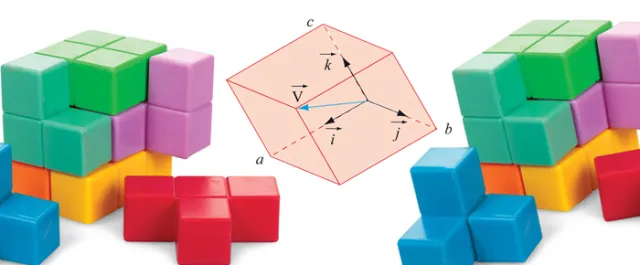
Consider a 2-dimensional space, such as the space of pairs of real numbers V = (x, y). Each vector can be expressed as a linear combination of the two vectors I = (1, 0) and J = (0, 1), since V = x I + y J. This decomposition is naturally unique, since x and y are the components of V. For this reason, the set {I, J} is called a basis of the vector space of pairs of real numbers: every vector can be expressed uniquely as a linear combination of I and J. The set {I, J} is not the only basis: there are infinitely many! For example, {(–π, 0), (0, )} would work just as well. However, every basis has the same number of elements—two in this case.
To see why, suppose that {U}, which has only one element, is another basis. In that case, both I and J can be expressed as linear combinations of U: that is, there exist a and b such that I = a U and J = b U. It follows that b I – a J = 0 (check it for yourself!). Since a is nonzero, because I is not equal to (0, 0), we can write J = (b / a) I. Thus, relative to the basis {I, J}, J has two distinct expressions, namely J = 0.I + 1.J and J = (b / a).I + 0.J, which is a contradiction. Therefore, {U} cannot be a basis of the space under consideration.