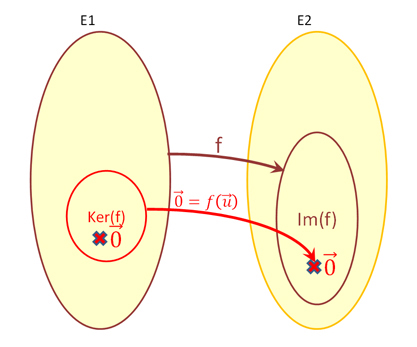
The image and kernel are two particularly important vector spaces—indeed, they are fundamental concepts in linear algebra. For a linear map f that maps each vector in the vector space E1 to the vector in the vector space E2, the kernel is defined as the vector subspace of E1 consisting of the elements such that . As its name suggests, the image is the vector subspace of E2 consisting of the vectors that are values of the linear map f; that is, there is a vector in E1 such that .
Natural though these definitions may be, they are terribly abstract!
Yet these concepts are ubiquitous in linear algebra. If f is an endomorphism, its image, denoted Im(f), and its kernel, denoted Ker(f), are vector subspaces (of E2 and E1, respectively). For example, in finite-dimensional spaces, Ker(f) consists solely of the zero vector if and only if f is a bijection… But let us not reel off the properties of the image and kernel: even this special issue would not be enough… Instead, let us use a game to see what they mean.