The gravity equation
------------------------
Thomas Chaney, one of the three nominees for the 2017 Best Young Economist Award, dared to tackle it. At 40, this economics professor at Sciences Po Paris was honored for his research, whose findings he brought together under the title The gravity equation in international trade: an explanation. Jan Tinbergen, who happened upon this famous "equation," drew inspiration from Newton's law of universal gravitation to describe the dynamics of trade between two countries. Under this law, the force exerted by body B on body A (and by body A on body B) is given by
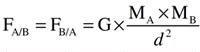
,
where G is the acceleration due to gravity, MA and MB are the respective masses of the two bodies, and d is the distance between them.
In Tinbergen's economic formulation, this becomes:
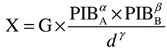
,
where X is the volume of trade between two countries A and B, whose respective gross domestic products are GDPA and GDPB, d is the distance between them, and G, , and are constants. Econometric studies show that and are stable and close to 1, and estimates suggest that the exponent is also close to 1. Thus, the larger the economies, the more they trade with each other; but the farther apart they are, the less they trade. Drawing primarily on trade in the kingdom of Assyria in the 19th century BC, Thomas Chaney showed the relevance of this law and then extended it to present-day trading practices.