
**
**
The luthiers' coded numbers
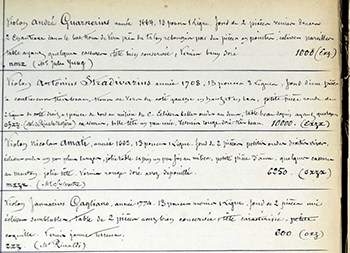
Jean-Philippe Echard, curator at the Musée de la musique within the Philharmonie de Paris, and Pierrick Gaudry, cryptographer and research director at the Laboratoire lorrain de recherche en informatique, studied these registers and decrypted the famous code.
The slips show four significant entries: the purchase price; the price offered for sale; the reserve price (below which the dealer would refuse to go); and the final amount of the transaction. For example, the slip opposite reads:
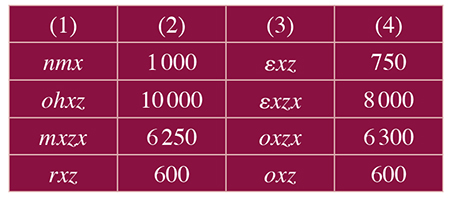
Since the numbers generally had one or two zeros on their right, it turns out that x and z coded for zero. For the leftmost digit, 1 or 2 came up most often, which already gives a clue. Finally, taking into account the inequalities "purchase price < reserve price < transaction amount," common sense does the rest. The key obviously has ten letters, and it is, unsurprisingly, the word "harmonieux." Thus h, a, r, m, o, n, i, e, u, x correspond respectively to the digits 1, 2, 3, 4, 5, 6, 7, 8, 9, 0. The luthier could encrypt and decrypt at a glance; he just had to remember that the z, a duplicate of x, was there to fool the enemy.