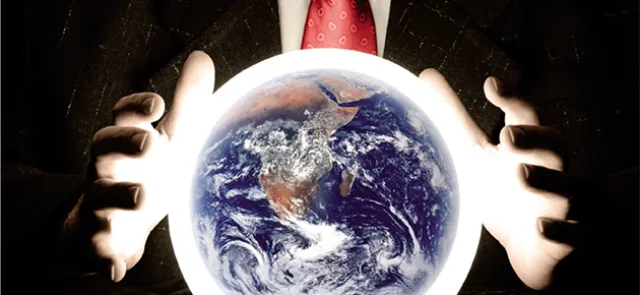
Birth: the moon is innocent!
-----------------------------------
According to a widespread belief, the number of births during the full moon is far higher than on other days. Admittedly, the moon's influence on life on Earth is plain to see; the tides are a visible example of it. Yet every study conducted in different countries to test this hypothesis has come back negative. In particular, an analysis of six hundred thousand births carried out between 1997 and 2001 in North Carolina (United States) found no correlation between the daily number of births and the phases of the moon.
So where does this persistent belief come from, one that the various denials do not seem to shake? Probably from the twenty-nine-day lunar cycle, very close to the average length of a woman's menstrual cycle… The astronomer Jean-Luc Margot, of the University of California, Los Angeles, author of a thoroughly documented article published in March 2015 in Nursing Research, attributes it to what he calls a cognitive bias: "People tend to interpret information in a way that confirms their beliefs and disregards data that contradicts them."
The zodiac and the precession of the equinoxes
------------------------------------------
The Earth spins like a top: its polar axis, tilted about 23 degrees from the plane of the ecliptic along which our planet moves, traces a circle every 25,760 years. Thus Vega, in the constellation Lyra, will be the pole star in twelve thousand years!
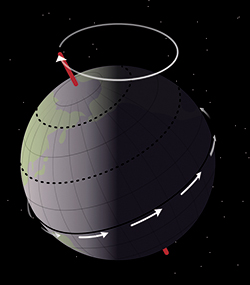
A distinction is then made between the sidereal year, which corresponds to the time the Earth takes to complete one full orbit, and the tropical year, which corresponds to the return of the vernal point marking the start of astronomical spring. The latter is shorter by about twenty-three minutes; after 25,760 years, the gap amounts to a full year: the top has completed one turn. This phenomenon is called the precession of the equinoxes, since the vernal point shifts back slightly along the Earth's orbit every year. Our calendar, concerned with keeping the seasons in place, is based on the tropical year.
In the middle of the 1st millennium BCE, the Babylonians had divided the ecliptic (the part of the sky through which the sun moves) into twelve equal parts, each bearing the name of one of the constellations found there. This then made it possible to divide the year itself into twelve. Aries, for example, corresponds to the period of the year during which the sun lies in the part of the ecliptic bearing that name. However, our present-day names refer to the positions observed in Ptolemy's time, in the 2nd century CE. Given the precession of the equinoxes, this shifts by one twelfth of the ecliptic, or roughly one zodiac sign every 2,150 years (one twelfth of 25,760 years). So nowadays the signs are out of step, and Aries begins on 15 April rather than 21 March!
Astrology in the Que sais-je series: Montaigne would have been lost for words!
---------------------------------------------------------------------------
The famous Que sais-je series has been publishing popular-science books since 1941, often written by specialists. Reading one seems to guarantee well-documented, serious knowledge.
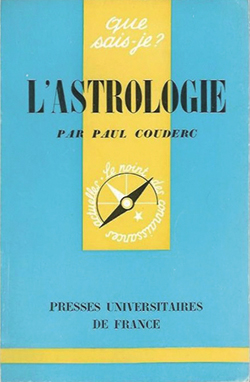
Yet on the subject of astrology, the series has shown a good deal of carelessness: three successive volumes, all bearing the same title, l'Astrologie, offered accounts ranging from the best to the worst. Volume 508 of the series, published in 1951 and written by Paul Couderc, was outstanding. It placed astrology in the realm of the pseudo-sciences and left no doubt about the utter lack of any rational foundation for the discipline. The author, a renowned astronomer, received the Kalinga Prize for the popularization of science, awarded by UNESCO, in 1966.
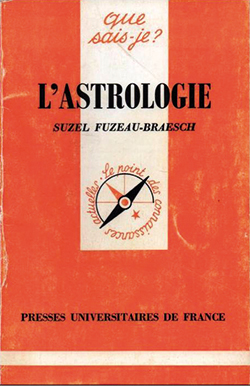
In 1989, volume 2481 appeared, bearing the same title and written by Suzel Fuzeau-Braesch. Although she held a science doctorate in chemistry, she sought, in vain, to give astrology a scientific footing.
awarded by UNESCO.
In 1989, volume 2481 appeared, bearing the same title and written by Suzel Fuzeau-Braesch. Although she held a science doctorate in chemistry, she sought, in vain, to give astrology a scientific footing.
Faced with the outcry this publication caused in scientific circles, the Que sais-je publishers asked two astronomers, Daniel Kunth and Philippe Zarka, to write a third volume. It appeared in 2005, bearing the same title and the same number as its predecessor. Scientifically sound, though less critical than Paul Couderc's, it seeks to understand why astrology continues to attract so much interest.