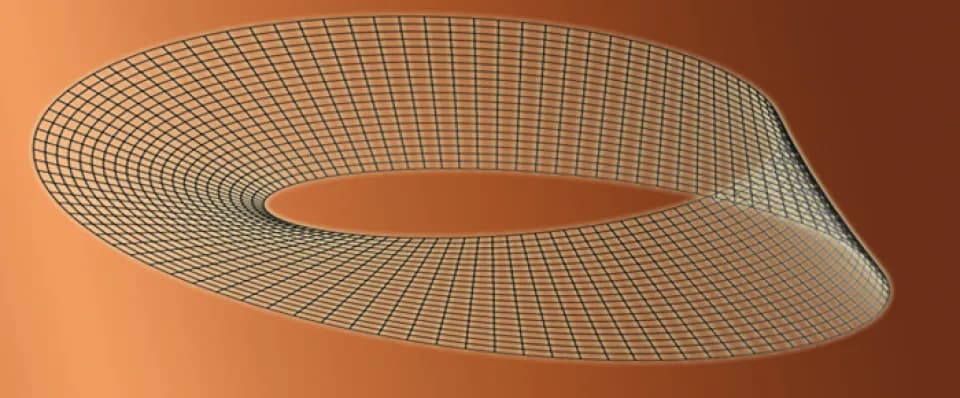
Every mathematics enthusiast has made a Möbius strip at least once. It is just the kind of remarkable mathematical object created in recreational mathematics workshops. Take a long strip of paper, give it a half-twist, and glue the two ends together: the result is a baffling topological surface with only one side (technically, it is non-orientable).
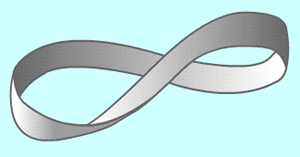
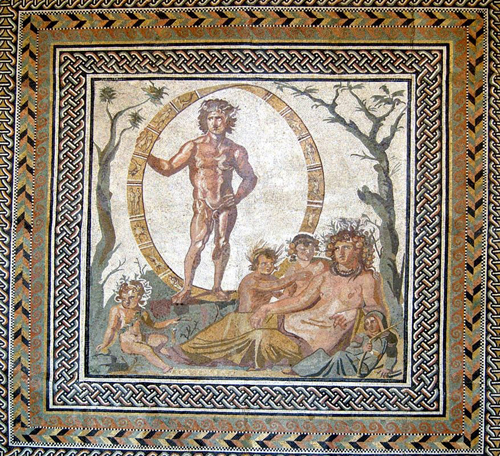
Surprisingly, this strip was already known to Belle Époque illusionists such as Thomas Nelson Downs (1876–1938) and Harry Blackstone Sr. (1885–1965), who called it the paradromic ring, the Bengal ring, or the Afghan loop. There is even a depiction of this famous strip alongside Aion, the god of time, dating from the late Roman period (3rd century CE).
To make a Möbius strip, simply cut a long rectangle from a sheet of paper, give it a half-twist, and glue its shorter sides together. Yet Tangente is about to let you in on a secret: the ring made this way is not truly a Möbius strip! No "concrete," physical object can ever be one. Like it or not, this ring—or rather, one-sided surface—is a plane bent into three-dimensional space, and a plane cannot have any thickness, even the few tenths of a millimetre found in a sheet of paper.