Many optimization problems arise from geometric situations: minimizing or maximizing lengths, areas or angles. Most obviously have an algebraic solution, but with a little ingenuity we can also find a purely geometric one—proof that optimization does not always require differentiation!
Notable examples
--------------------
According to legend, Elyssa, princess of Tyre, fled her brother Pygmalion after he murdered her husband in the 9th century BCE. She found refuge in what is now Tunisia, where the local inhabitants granted her only as much land as could be covered by… an oxhide. Undeterred, she cut the hide into thin strips and joined them into a four-kilometre rope, which she used to best advantage to enclose her territory and found the city of Carthage, whose first queen she became under the name Dido. Dido's problem is one of the oldest isoperimetric optimization problems: maximizing an area for a given perimeter. The territory envisaged by Dido would be a semicircle whose diameter lay along the shore of the Gulf of Tunis.
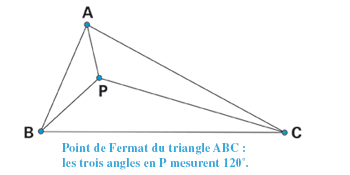
A little closer to our own time, another splendid optimization problem was first posed in 1636 by Pierre de Fermat, a magistrate with a passion for mathematics, in his Method of Maxima and Minima: "Given three points, find a fourth such that the sum of its distances from the three given points is minimal." Four years later, Evangelista Torricelli proposed a geometric solution, which later mathematicians improved, often still working entirely within geometry: Bonaventura Cavalieri in 1647, Vincenzo Viviani in 1659, Thomas Simpson in 1750, Franz Heinen in 1834… We now know that, provided none of the triangle's angles exceeds 120°, the solution is a unique point inside the triangle—called the Fermat point, or Torricelli point—at which the three sides subtend angles of 120°.