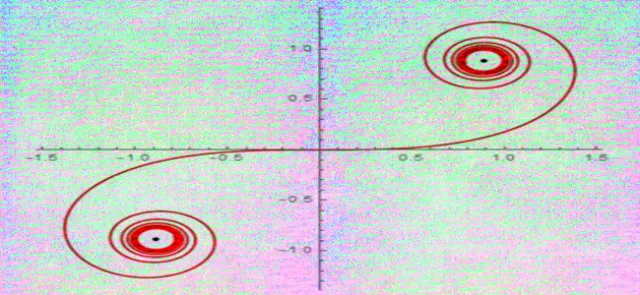
In his magnificent autobiography, the great 20th-century physicist Richard Feynman recounts a mathematical prank he played as a student. Someone had asked whether the shape of a French curve could be described mathematically. "Of course!" he replied mischievously. "These curves are very special. They are made so that, at their lowest point, no matter how you turn them, their tangent is horizontal." The other students marveled at this supposedly unique property…
The marriage of a curve and a line
---------------------------------------
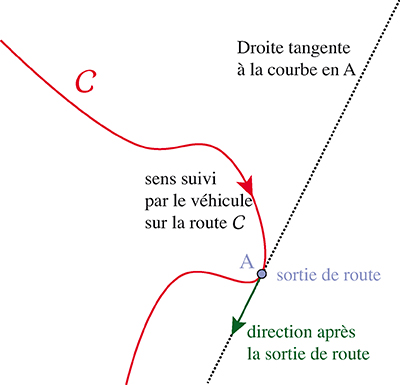
Feynman knew something that, curiously, the other students at the Massachusetts Institute of Technology did not: at the lowest point of any reasonably "smooth" curve, the tangent is horizontal. A rudimentary definition of the tangent to a curve at a point is enough to see why. Let C be any "sufficiently regular" curve (a notion whose precise definition depends on the context), and let A be a point on it. The tangent to C at A is the line that "best" follows the shape of the curve near A. Imagine that C traces the path of a road along which a car is traveling. The tangent points in the direction the car will travel if, at A, a large patch of ice suddenly makes it skid and it can no longer control its direction.
Another way to visualize the tangent is to zoom in ever more closely around A. If C is sufficiently regular, then as we zoom "closer and closer," we find that immediately around A, the curve is practically indistinguishable from a straight line.