



Curiosity
Patterns, crafts, magic squares and fun mathematical content not part of the school curriculum
 Podcast
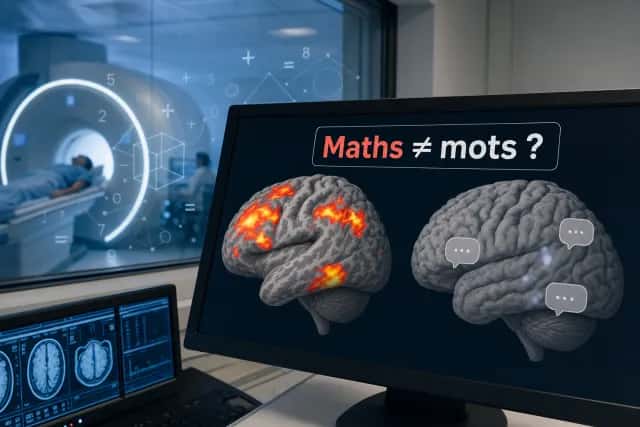
Do you think in words when solving an equation?
Neuroscience reveals that the brain processes mathematics through networks distinct from those of natural language, calling into question our understanding of mathematical cognition.
 Podcast
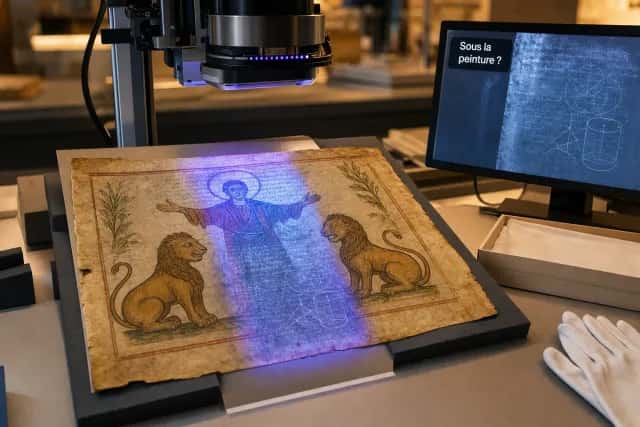
Archimedes page found at Blois museum: palimpsest and ancient geometry
Victor Gysembergh has found a leaf from the Archimedes palimpsest, missing since 1906, hidden beneath an illumination of the prophet Daniel at the Musée des Beaux-Arts in Blois.
 Podcast
CubeHarmonic: the Rubik's Cube that makes algebra audible
Invented by Maria Mannone, the CubeHarmonic uses a Rubik's Cube to create musical harmonies and teach algebra intuitively.
 Podcast
Year 2038 bug: the 32-bit timestamp problem explained
A massive bug related to the way computers represent large numbers looms on January 19, 2038, at 3:14:08 a.m.
 Podcast
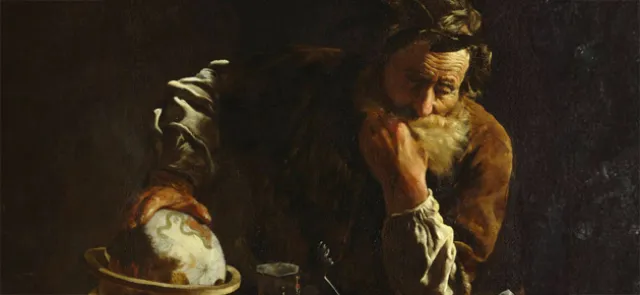
Archimedes' Sand Reckoner: counting the grains of sand in the universe
If the universe is finite, then it can be filled with grains of sand. Yes, it would take a great many, but the quantity required would still be a finite number—one that can be expressed. Drawing on the most advanced astronomical knowledge of his time, Archimedes set out to do just that.
 Podcast
666: When the devil shows up in math | Tangente
From the biblical 666 to the Belphegor number, certain numbers send a shiver down the spine… and bring a smile to mathematicians' faces. Behind these "cursed" objects, the creativity and ingenuity of recreational mathematics run wild, ranging from number games to diabolical curiosities.
 Podcast
Mathematical properties of 2026 | Tangente
Let's not break with our start-of-year tradition and explore together a few charming quirks of the new vintage!

Blaise Pascal’s Pascaline | Tangente
This past November 19, a Pascaline dating from 1642, valued at between two and three million euros, was due to go under the hammer at Christie’s in Paris.
 Podcast
Vampire numbers and their fangs | Tangente
Yes, vampire numbers really do exist! And they have fangs!
 Podcast
Parasitic numbers and permutations | Tangente
How do you multiply 105,263,157,894,736,842 by 2? Simple: just move the final digit, 2, to the front of the number, giving 210,526,315,789,473,684. And there you have it!
 Podcast
Conway's power trains | Tangente
Power trains are iterated functions introduced by Conway.
 Podcast
Prime numbers and changing digits | Tangente
Unlike some composite numbers, it is hard to tell whether a number is prime just by looking at it. So what happens to a prime number if we make a change to its digits — for example, by permuting them or removing some of them? Can it stay prime? Or, on the contrary, does it stop being prime?
 Podcast
Palindromic numbers: numerical symmetry | Tangente
These numbers, which can be read equally well from left to right or from right to left, raise questions. At first glance they seem highly unusual, and therefore rare. Yet when an elementary arithmetic process is repeated on any whole number whatsoever, we almost always end up with just such a number. Bizarre, how bizarre!
 Podcast
It doesn't take much to be happy
We know that mathematics can be a source of joy, but have you heard of happy numbers? Simple to define, they hold plenty of surprises and show just how much playing with integers remains an inexhaustible source of research at every level.
 Podcast
Maryam Mirzakhani, from Tehran to Stanford | Tangente
A brilliant, passionate young woman, Maryam Mirzakhani turned her curiosity into an exceptional scientific career. Her optimistic outlook and perseverance changed the place of women in a field long dominated by men. Her life, brief but luminous, continues to inspire.
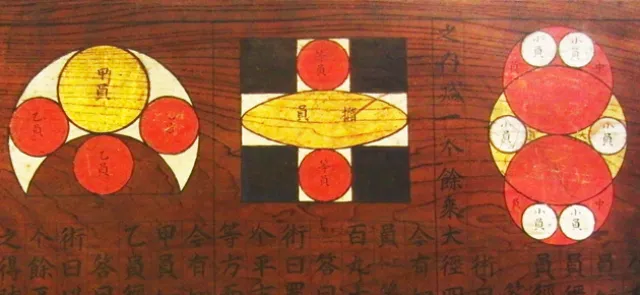
Sangaku: geometry in Japan's temples | Tangente
Sangaku are a remarkable practice, bringing together mathematics, art and spirituality. They offer a precious glimpse into the mathematics practiced during the Edo period and give a sense of how sophisticated popular mathematical culture was at the time.
 Podcast
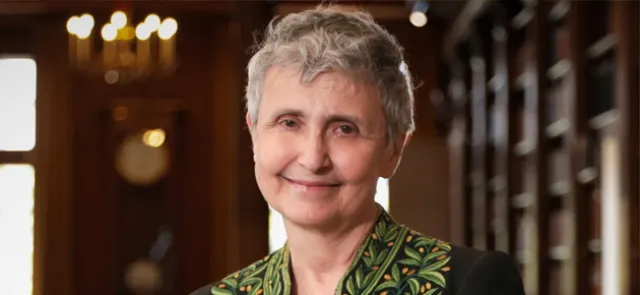
Karine Chemla, mathematician and sinologist | Tangente
Karine Chemla is a central figure in the history of mathematics in China, which she has helped make accessible to a wide audience. A mathematician, historian and translator all at once, she looks back on her rich career and her work.
 Podcast
Making art with the Conway knot | Tangente
An artist passionate about mathematics, Michel Delaunay creates works that plunge the eye into the infinity of geometric and topological aesthetics. He notably combines the potentialities of the cube with those of the Conway knot.
 Podcast
Saint-Simon's dream of a mathematized... | Tangente
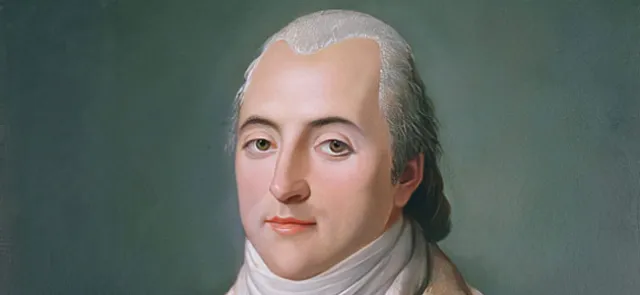
In 1820, Saint-Simon proposed a complete reorganization of political life in which he imagined handing power to mathematics. Although his project was never implemented, it directly influenced the emergence of technocracy and our conception of expertise in politics.
 Podcast
Roger Mansuy's mathematical almanac | Tangente
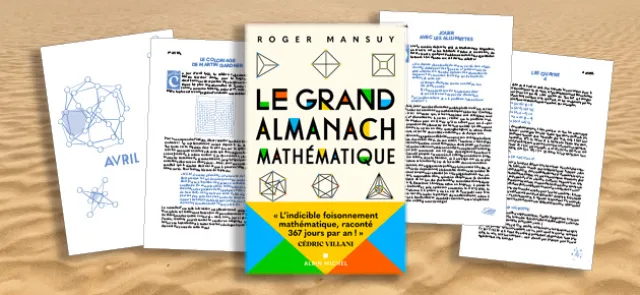
On the occasion of the publication of his Grand almanach mathématique (The Grand Mathematical Almanac), Roger Mansuy opens up to Tangente about the secrets of this book like no other, in which readers discover, among others, many unjustly forgotten figures.