



Games and Challenges
Mathematical problems, games and challenges

The surprising aperitif problem | Tangente
Where should a platter of canapés be placed to satisfy the guests as well as possible? This seemingly innocuous problem has inspired brilliant developments over the centuries. It also illustrates how individual and collective optimization are often at odds—a seemingly paradoxical result.

Allais and the limits of utilitarianism | Tangente
The paradox formulated by the French economist Maurice Allais exposes a contradiction in an earlier theory of decision-making. But the paradox is only apparent and, above all, illustrates a major limitation of rational choice theory.

The two-envelope paradox | Tangente
A paradox can sometimes resemble an urban legend. First, its precise origins may be difficult to pin down; second, over time it may become distorted, change form, and proliferate. Such is the case with the two-envelope paradox.
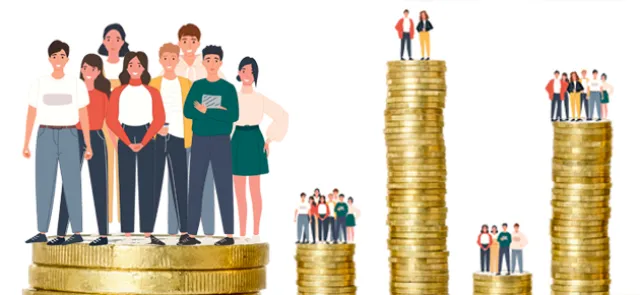
Simpson's paradox and appearances | Tangente
Could something that is true in every subgroup of a population become false when the population is considered as a whole? How is that possible? This is exactly what Simpson's paradox—the best-known paradox in statistics—shows.

The notion of paradox in mathematics | Tangente
The terms "paradox" and "paradoxical" are part of everyday language. In mathematics and logic, however, they have precise meanings that need to be clarified if we are to understand what we are talking about and what status to assign to so-called "paradoxical" results.

Old-time fraction puzzles to solve | Tangente
Thirds, quarters and other fractions have long provided the basis for puzzles in a wide range of settings. Here are three from centuries past.

Gilles and the mathematics culture and games fair | Tangente
Two passions guided Gilles throughout his life: puzzles and popularizing mathematics.
2023 Tangente Awards winners | Tangente
Since 2010, the Tangente Club has used the Tangente Awards to honor creative works that showcase mathematics. The winners receive a work of art. The awards ceremony took place at the Musée des Arts et Métiers in Paris on December 3, 2023, during Tangente Day.
On the road – Mathematical brief | Tangente
Both unusual—since it does not usually rest on its "base"—and harmonious, as it is a quadrilateral with four equal sides, the rhombus appeals to graphic artists, advertisers and other designers: it appears in puzzles, games, road signs, logos…
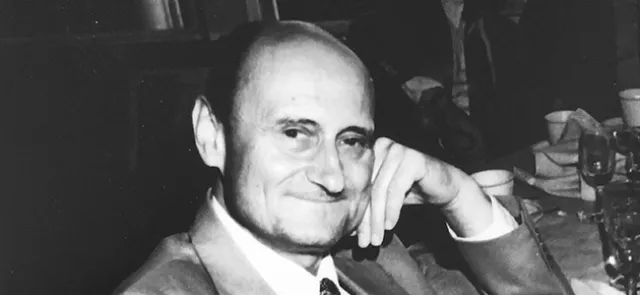
Egon Balas | Tangente
Egon Balas's life story reads like an adventure novel. Discover the remarkable story of this mathematician from communist Romania, who managed to escape the turmoil brought upon him by his love of freedom and whose name is associated with numerous discoveries, particularly in operations research.

Mathematical games: 2023 final | Tangente
After two years without an international final because of the pandemic, the 36th Championship held its final outside France for the first time, in Lausanne, Switzerland, while the final round of the 37th Championship will take place on August 25 and 26, 2023, at Wroclaw University of Science and Technology in Poland
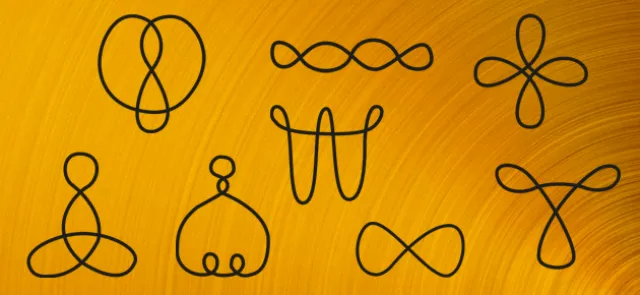
Identifying knots with Gauss codes | Tangente
A visual encoding introduced by Gauss to make knots easier to recognize and manipulate leads to surprising developments in combinatorics, algebra and topology. Armed with paper, pencil and a few pieces of string, let's explore this world.

Classifying knots: topology and invariants | Tangente
Knots can be combined to form new ones—or, conversely, simplified. We can borrow the vocabulary of number theory and classify them rather like the chemical elements. What varied and unexpected facets knot theory has!
Converging to a number: is there only one way?
Traditional mathematics provides a precise definition of convergence for a numerical series, explored in the main body of this article. But this should not rule out less conventional approaches, discussed in the box and in several articles in this special issue.
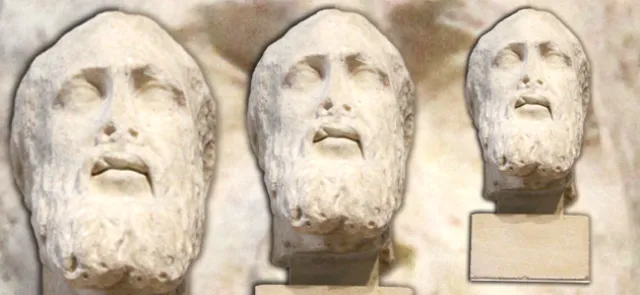
Infinite sums: a matter of convention
Equality between two numbers poses no difficulty when both are defined by "finitary"* methods. But as soon as infinity enters the picture—represented by ellipses in formulas—the door opens to all manner of paradoxes. (* Finitism is an approach to mathematics that considers only finite objects.)
Catalan's problem
In 1844, Franco-Belgian mathematician Eugène Catalan published his famous conjecture in Crelle's Journal.
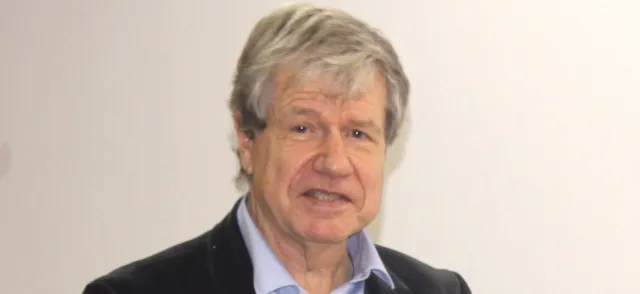
Hervé Lehning, a popularizer of mathematics | Tangente
It is impossible to sum up the scientific and educational work of a man such as our colleague and friend Hervé Lehning. More than a thousand articles bear his name! One way to gain a sense of the man is through his vast body of writing.
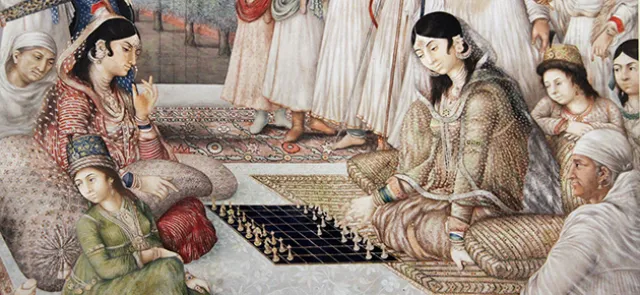
From Sissa to RSA
What use is there in raising numbers to powers, except for the fun of uncovering some arithmetical property of the natural numbers? Unexpectedly, this ancient computational art lies at the heart of modern cryptography and secure data transmission.

Catriona Agg's geometry puzzles | Tangente
Catriona Agg (until recently also known as Catriona Shearer) is a British mathematics teacher from Cambridge.

A theorem puzzle in pictures: Monday's challenge | Tangente
Since 2015, the Image des maths website (https://images.math.cnrs.fr) has featured a "picture-theorem puzzle" every Monday, taken from Geometry in Figures, a book published in 2011 by the young Russian mathematician Arseniy Akopyan (CreateSpace Independent Publishing Platform) and available in French as Figures sans paroles (Independently Published, 2019).