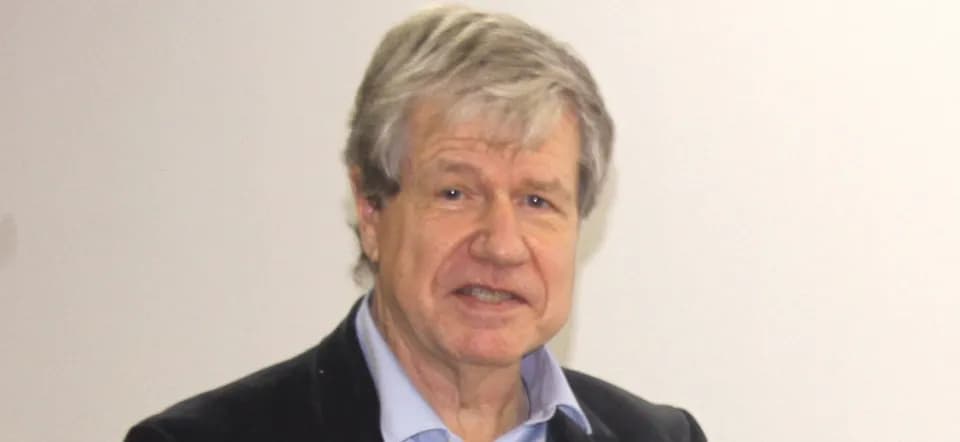
Hervé Lehning passed away a few months ago (see Tangente 208, 2022). This extraordinary mathematician devoted most of his career to sharing his passion for mathematics. His prodigious capacity for work and his gifts as a teacher won over generations of students in classes préparatoires, who also remember that, as soon as each written examination ended, a fully worked solution was already available, while their marked and annotated papers were invariably returned at the very next class.
But Hervé's influence extended far beyond his teaching. He always sought to devote a large part of his work to bringing mathematical knowledge to the widest possible audience. More than a thousand articles bearing his name can be found in many renowned popular-science magazines. Any comprehensive survey is therefore impossible. Hervé also wrote some thirty major books, substantial in both length and content. These may be the ideal medium through which to explore the legacy of this great humanist.
Teaching as a vocation
-----------------------------
In the early 1980s, Hervé Lehning identified and anticipated the population's future needs by launching, together with fellow mathematics teacher Daniel Jakubowicz, a series of volumes, each more than a hundred pages long, explaining Mathématiques par l’informatique individuelle (Masson; volume I: "Le Basic, arithmétique, cryptographie, équations," 1982; volume II: "Approximation, sommation," 1982; volume III appears never to have been published; volume IV: "Graphisme," 1984). His path was clear from the outset: teaching, real-world applications and a determination to share his knowledge would be his guiding principles. The end of the decade also saw the publication of five substantial volumes intended, among others, for his students, under the title Mathématiques supérieures et spéciales (Masson; volume I: "Topologie," 1985; volume II: "Dérivation," with Daniel Jakubowicz, 1986; volume III: "Intégration et sommation," 1985; volume IV: "Analyse en dimension finie," 1986; volume V: "Analyse fonctionnelle," 1988).
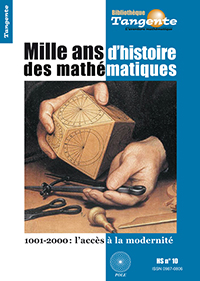
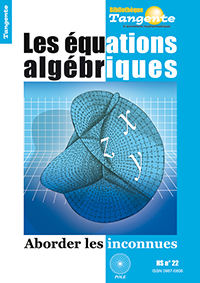
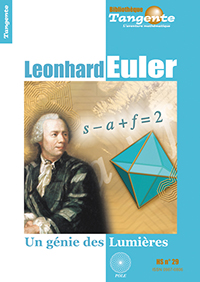
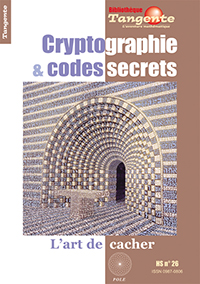
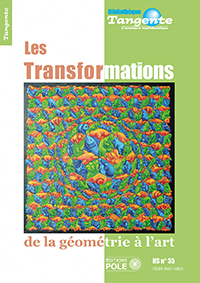
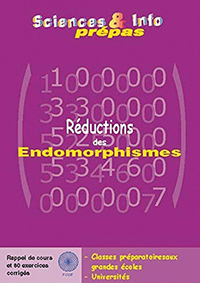
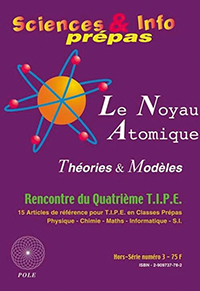
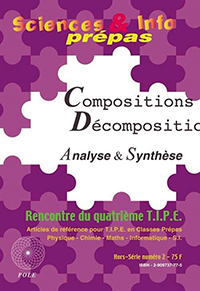
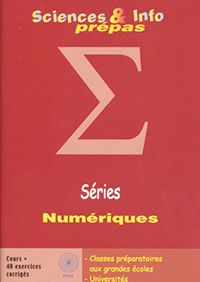
Teaching was his vocation, but his ambition was broader: Hervé wanted to reach the general public. Doing so in mathematics is no mean feat. This marked the beginning of a long collaboration with Tangente and Éditions POLE, starting with the publication of two books on the Maple software package (Maplesoft, 1982): Apprentissage rapide de Maple in 1998 and Travaux pratiques avec Maple in 1999 showed users how to harness the interface for the analysis, visualization and solving of sophisticated mathematical problems. The adventure continued. Working with the Tangente team, Hervé tackled every field. He was an extraordinarily prolific and well-informed author, capable of writing on any subject and proficient with digital tools such as vector-graphics software, which enabled him to produce the geometric figures and technical diagrams illustrating his own texts. For the "Sciences et info prépas" series, he wrote Réduction des endomorphismes in 2000 and co-authored *Le Noyau atomique, théories et modèles, Composition et Décomposition and Séries numériques in 2001. For the Bibliothèque Tangente, he edited Maths et Sports in 2004, Les Équations algébriques and Mille ans d’histoire des mathématiques in 2005, Cryptographie et Codes secrets in 2006, Leonhard Euler in 2007, and finally Les Transformations in 2009. Alongside these activities, he was deputy editor-in-chief of Tangente from 2004 to 2015, and editor-in-chief of Sciences et Info Prépas and then Tangente SUP*, from 1999 until 2014, when the magazine ceased publication. His editorial policy could be summed up in a few words: sweep nothing "under the rug," provide complete explanations and proofs, and carry every calculation rigorously through to the end.
Yet even that did not seem enough to him! Hervé wanted to reach everyone—including, and perhaps above all, "people who are not mathematicians." That is why he agreed to write regular columns for the magazine La Recherche ("Bac to basics") and for Pour La Science.
Reaching every citizen
------------------------------
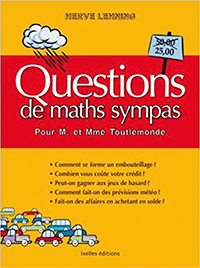
This led to the publication of *Questions de maths sympas pour M. et Mme Toulemonde*, issued by the Belgian publisher Ixelles édition in 2011. Our author threw himself into it with delight. Using the world around us as his vehicle, he set out to provide every reader with a basic grounding in mathematics. The book covers many everyday subjects, including loan rates, insurance, speed cameras, GPS, crowd behavior, overbooking, vaccinations, the curves of skatepark ramps and even the geometry of a soccer ball (see the review published in Tangente 141, 2011). Each is presented in a mathematical framework that sheds light on it while giving readers access to the basic theoretical tools. The book also provides a clear, comprehensive glossary that readers can consult along the way, ensuring that no one is left behind. Mathematics leaves its ivory tower to reach everyone. The book duly won the 2011 Tangente Prize. It was subsequently published in the Librio series in 2013 under the title *Questions de maths utiles : soldes, sondages, loto, radars*. It was reissued in 2021.
As a mathematician, Hervé also had passions that he was determined to share. Conic sections, which frequently appeared in the pages of Tangente SUP. Beautiful geometry, which he was eager to restore to its rightful place, as this remarkable article—one among a hundred others—shows: Courbes orthoptiques et Friandises géométriques (Les Angles, Bibliothèque Tangente 53, 2015). It is deeply regrettable that Hervé did not have time to publish a fine anthology paying tribute to the geometry that fascinated him so greatly.
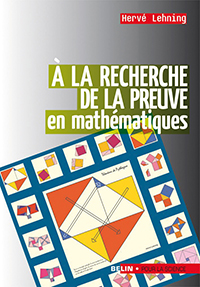
An admirer of "beautiful" proofs, he published *À la recherche de la preuve en mathématiques (Belin, 2009). A vast subject, also encompassing logic, aesthetics and the incompleteness of arithmetic, proved by Kurt Gödel in the early 1930s. It was a harsh lesson in humility for mathematicians, who had to acknowledge that all their proofs rest on unstable, arbitrary foundations—the axioms—that there are therefore as many structures as there are ways of choosing those axioms and that, despite every precaution, some results prove unprovable and others undecidable. The book is also a remarkable philosophical essay, reflecting on every kind of reasoning, from the "most rigorous" proofs to justifications and proofs without words. As the review published in Mathématiques et Philosophie* (Bibliothèque Tangente 38, 2010) explains: "Reasoning by analysis and synthesis can already produce an initial sense of wonder—the kind inspired by proof by contradiction. Visual representations such as dissections or colorings hold still more emotional power, but beware of the pitfalls! Like any analogy (the author calls it a 'transfer of properties'), they require us to examine the justification of 'proofs without words.'"
Numbers and secret codes
------------------------
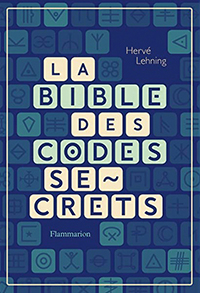
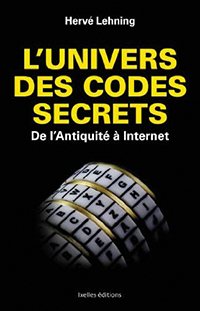
It is difficult to discuss Hervé's work without entering the highly specialized field of cryptology. On two occasions, he presented us with two substantial specialist treatises on the subject. In 2012, L’Univers des codes secrets, de l’Antiquité à Internet (Ixelles) was published. Blending major historical events with a wealth of colorful anecdotes, the author invites us to discover the feats of ingenuity devised over the centuries to conceal information on the one hand and to decipher it on the other. We learn the principles behind ASCII (American Standard Code for Information Interchange, a computer standard for character encoding), Wi-Fi, the encryption of our cell phones and bank cards, and the RSA cryptosystem, widely used to exchange confidential data online. Hervé then returned to the subject with his *Bible des codes secrets*
(Flammarion, 2019), allowing us to join Homer, Caesar, Louis XIV and Marie Antoinette in their desire to communicate secretly. We also encounter great mathematicians, from Viète and Cardano to Turing. The review published in Tangente 191 (2020) emphasizes the book's distinctly mathematical character: "As a useful art for understanding logical structures, mathematics is present through the involvement of several mathematicians […]. It has now become indispensable to modern coding."
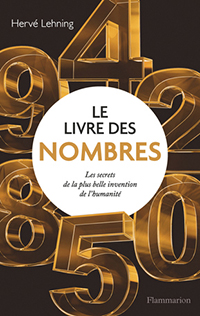
Numbers were also Hervé's constant companions throughout his life, as shown by L’Univers des nombres, de l’Antiquité à Internet (Ixelles, 2013) and *Le Livre des nombres (Flammarion, 2021). "More than merely yet another book about numbers, [the first of these two books] 'translates' them for those unfamiliar with them, rather as the Vulgate made the Bible accessible by translating it into Latin. Almost everything you always wanted to know about numbers but were afraid to ask is here. […] This book does not claim to rebuild number theory; quite simply, it attempts to answer your questions,"* explained the review published in Tangente 153 (2013). As for the second book, the last Hervé published during his lifetime (see box), the review in Tangente 202 (2021) sheds light on its content and approach: "The book goes back 20,000 years before the Common Era to explore the birth of numbers, the Mesopotamians and Mayas, the Egyptians and Romans, the Chinese, Indians and Arabs. The logic of each system is set out, and every new tool is justified by a practical problem that arose. The book then moves on to operations, from abacuses to algorithms, 'the' zero, rational numbers, equations and imaginary numbers, the most famous mythical numbers, the magic square and infinity. Misleading probabilities and statistics, based on poorly understood computer models, are laid bare. The final chapter opens with the Covid-19 pandemic and sounds rather like a warning against the misuse of digital technology."
One of Hervé's last outstanding works of popular mathematics—perhaps his most successful in terms of its reach, since it was notably translated into Chinese!—encapsulates his ambitions in its title: Toutes les mathématiques du monde (Flammarion, 2017). Hervé warns us in the opening pages: "At times, you will feel as though you have stepped onto a fairground ride." The review published in Tangente 179 (2017) highlighted this aspect: "A sense of vertigo at the whirlwind of mathematical knowledge teeming through this volume; vertigo again at the depth of thought inspired over the centuries by mathematical theories, proofs and constructions; and vertigo, finally, at the vistas opened up by mathematics today. […] [The variety of subjects covered] reflects the abundant beauty of mathematics, its fruitfulness and its universality, which the author has captured so brilliantly."
So much so that we can only ask with excitement: what will the mathematics of tomorrow be like? This 450-page book, best read without restraint, encapsulates its author's entire body of work through its density and its drive to reveal the variety and beauty of mathematics, its extraordinary fruitfulness and its universality. It was the work of a lifetime, as its author explained at a public lecture in Brussels, Belgium: "I am often asked how long it took me to write this book. The answer is simple: twenty-five years—from the day I began contributing to Tangente."
\* All the reviews mentioned in the text are available online at www.tangente-mag.com.