



Famous figures
Portraits of famous mathematicians, historical and contemporary

Properties of the arithmetic triangle
Although Blaise Pascal did not invent the triangle that bears his name, the name pays tribute to his study of it in a treatise that has remained famous in the history of mathematics. Let's delve into this extraordinary text!

Pierre de Fermat, Pascal's famous contemporary | Tangente
Who was Pierre de Fermat? Pascal regarded him as the greatest mathematician of his time. He was a very modest man, probably aware of his extraordinary mathematical abilities, who readily shared his often original ideas. We know that he was a man of great learning, capable of translating works from Latin and Greek and writing sophisticated poetry, even… in Spanish.

Pascal and geometry: the mystic hexagram | Tangente
Blaise Pascal's earliest work in geometry has passed into legend. He was only 16 when he published his Essay pour les coniques (Essay on Conics) in 1640.
Pascal on stage — Descartes and Pascal on stage | Tangente
The mathematician is also one of the central characters in a philosophical comedy by Jean-Claude Brisville (1922–2014), best known to the general public for Le Souper (1989), featuring Talleyrand and Fouché, whose film adaptation was a memorable success.

Pascal, hero of Italian cinema — Rossellini's film | Tangente
The film is little known to general audiences today, but Blaise Pascal is the title character of a feature film directed in 1971 by Roberto Rossellini, a leading figure of Italian neorealism.

Pascal on a 500-franc banknote | Tangente
Known as the "Pascal", this 500-franc note bearing the scholar's portrait had a long career: it remained legal tender from 1969 to 1997.

Pascal in space: a lunar crater | Tangente
Astronomy has paid tribute to Pascal twice.
Centre international Blaise-Pascal (CIBP) | Tangente
Among its missions, the Centre international Blaise-Pascal is compiling a comprehensive bibliography of research on Blaise Pascal.
Blaise Pascal prize — Researcher award | Tangente
The Blaise Pascal Prize recognizes work carried out in France on the application of mathematics to engineering and industry.

Fondation Blaise-Pascal—Maths for all | Tangente
The Fondation Blaise-Pascal was launched in 2016 by the CNRS, Université de Lyon and Inria. Its aim is to support mathematics and computer science outreach organizations, enabling them to develop and sustain their activities over the long term.

Pascal's 400th anniversary in Clermont | Tangente
In Auvergne, the city of Clermont-Ferrand, Clermont Auvergne Métropole and the University of Clermont Auvergne (UCA), together with their many partners, are preparing to celebrate the 400th anniversary of Blaise Pascal's birth in 2023.

Nalini Anantharaman at the Collège de France | Tangente
She was among the favorites for a Fields Medal in 2014; now she has been awarded a chair at the Collège de France!

The last two sangaku solved | Tangente
Of all the sangaku on record, two have proved particularly difficult to solve. The Japanese mathematician Yamaguchi Kanzan (c. 1781–1850) collected them in his travel journal between 1817 and 1828.
Cantor−Bernstein:
Georg Cantor left his mark on the history of mathematics through his study of infinite sets. The Cantor–Bernstein theorem shows how a few results that are obvious for finite sets generalize to infinite sets… provided one takes a serious look at the question.
A journey into infinity | Tangente
While many mathematicians toiled in the footsteps of their predecessors, Cantor opened up an entirely new field that many of his colleagues refused to enter. This journey through the different infinities proved to be both fascinating and fruitful.
Constructing tangents
If we know how to carry out the classic straightedge-and-compass constructions, we are perhaps less at ease drawing the common tangents to two circles. Now is the time to put our whole range of knowledge of Euclidean geometry into practice!
Deviation of a curve from a tangent
Newton and Leibniz, the founders of differential and integral calculus, studied how a curve deviates from a tangent. To this end, they drew on the notion of curvature. The fundamental ideas of these two scholars gave rise to contemporary mathematical analysis.
Beyond Descartes
Several results in the plane and in space generalize Descartes' theorem on the curvatures of tangent circles.
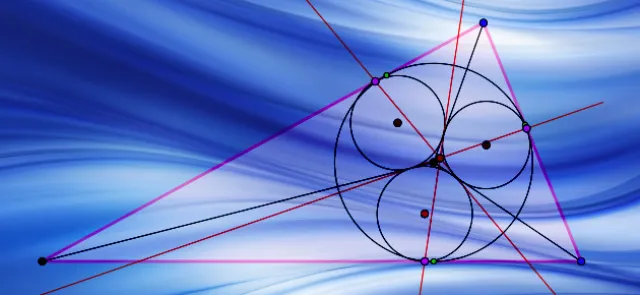
The Malfatti circles in a triangle | Tangente
In a triangle, how should three non-overlapping circles be chosen so as to minimize the area of the triangle left over once the three circles are removed? A natural solution, involving tangents within the triangle, is not the best one, but it gives rise to interesting problems.
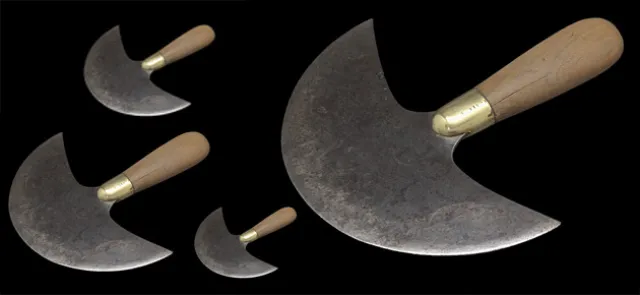
The arbelos
The properties of the arbelos, this fascinating geometric object studied since antiquity, are countless. How did the Greeks go about establishing such results? Let's look at a few clues, drawing on the texts handed down to us by Archimedes and Pappus.