



Numerical
Explore mathematics articles on the theme of numerical.
 Podcast
Sak Tahn Waax: the first Maya mathematician to sign his calculations
Discovered at Xultún in Guatemala: the signature of the first formally identified Maya mathematician, Sak Tahn Waax, who calculated the cycles of Venus and Mars around 781 CE.
 Podcast
Do you think in words when solving an equation?
Neuroscience reveals that the brain processes mathematics through networks distinct from those of natural language, calling into question our understanding of mathematical cognition.
 Podcast
Two billion smartphones turned into a seismograph network
Explanation of the Android earthquake alert system that turns the accelerometers of two billion phones into an early earthquake detection network.
 Podcast
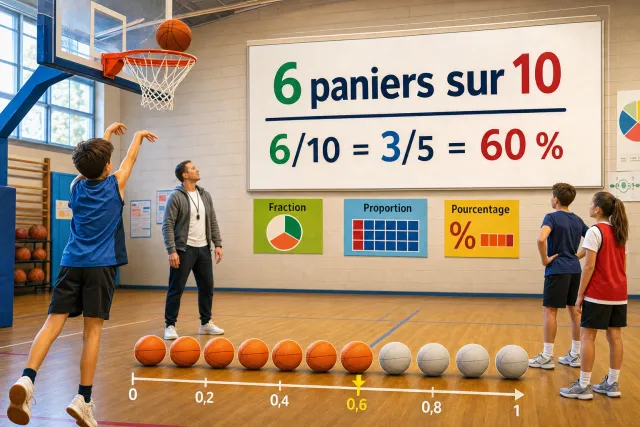
Can you learn fractions by shooting a basketball?
A Norwegian study demonstrates that basketball exercises help students aged 11 to 13 improve by 15% in fractions, thanks to learning through the body.
 Podcast
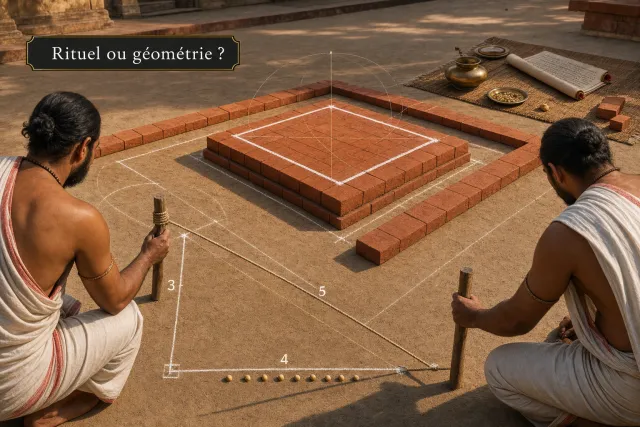
Vedic mathematics: a history of ritual geometry and the Śulba Sūtras
Discover how Vedic rituals gave rise to some of the oldest geometric, arithmetic and algorithmic texts in human history.
 Podcast
Ace: the math-powered robot beating ping-pong champs
Discover how Ace, a robot that combines reinforcement learning with event-based vision, can beat ping-pong champions. We break down the mathematics behind this feat, published in Nature.
 Podcast
Ackermann-Péter function: recursion without bounds
With a surprisingly simple definition, the Ackermann–Péter function generates numbers of a staggering size. This mathematical construction, born out of research into computability, shows how quickly a recursive procedure can exceed all the usual bounds.
 Podcast
Mersenne primes: discover perfect numbers
The search for Mersenne primes very quickly leads us to examine gigantic numbers.
 Podcast
Year 2038 bug: the 32-bit timestamp problem explained
A massive bug related to the way computers represent large numbers looms on January 19, 2038, at 3:14:08 a.m.
 Podcast
Knuth and Conway notations for mind-boggling numbers
When it comes to representing extremely large numbers, the standard operations, including exponentiation, are no longer enough. With considerable imagination, Donald Knuth and John Conway devised notations to overcome this limitation.
 Podcast
Long and short scales: billion, trillion, milliard—how to name large numbers
From colossal fortunes to the limits of mathematical language, words struggle to keep pace as numbers explode. From long and short scales, through international conventions, to mathematicians' bold inventions, the way we name extremely large quantities tells a story in which language, science and imagination meet.
 Podcast
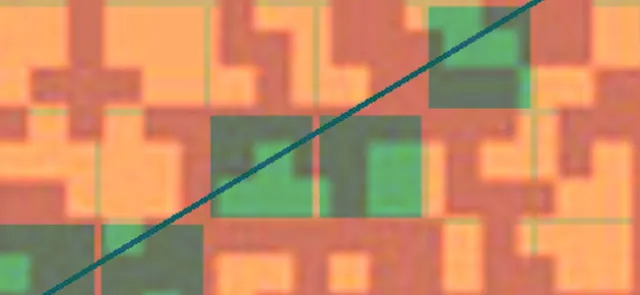
Discrete lines: the birth of a new geometry
Problems involving representation on a pixelated screen belong to discrete geometry. But beyond mere aesthetic considerations, are these new subjects of study—including discrete lines—tools for exploring Euclidean geometry more deeply, or objects of a new geometry?
 Podcast
Archimedes' Sand Reckoner: counting the grains of sand in the universe
If the universe is finite, then it can be filled with grains of sand. Yes, it would take a great many, but the quantity required would still be a finite number—one that can be expressed. Drawing on the most advanced astronomical knowledge of his time, Archimedes set out to do just that.

Computer geometry: Cabri and GeoGebra | Tangente
Although computer drawing had been possible since the 1970s, so-called "dynamic geometry" software did not become widespread until the 1980s.
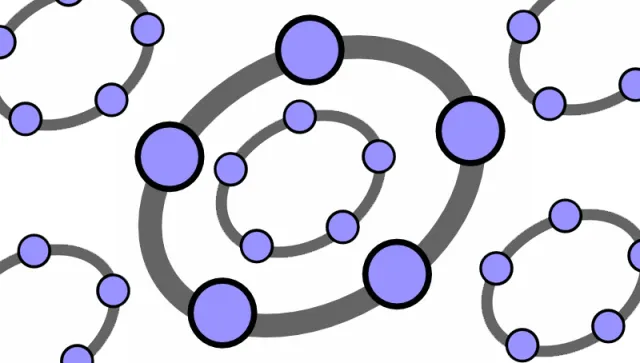
Dynamic geometry in action with GeoGebra | Tangente
Developed in 2002 by an Austrian student, GeoGebra is an educational tool with an unusual history. Designed for mathematics teachers worldwide, it is especially popular among secondary-school teachers in France. Tangente spoke with the software's creator, Markus Hohenwarter.

Writing a Wikipedia article—why not… | Tangente
Whenever people have a question or want to check a concept, Wikipedia has become the first port of call for many. But who writes these articles? Can they be trusted? Above all, how can you write one yourself?
Lean: a new library of Alexandria | Tangente
Building a digital repository of mathematics—a new "Library of Alexandria for mathematics"—is the wildly ambitious collaborative undertaking on which many mathematicians have embarked.

Toward new practices | Tangente
Mathematical research and teaching increasingly rely on software that supports collaboration. As this software grows more complex, its development requires large-scale collaboration.

Loops in programming | Tangente
The various types of loops are fundamental programming constructs. Although using them often comes naturally, they nevertheless raise a number of issues, such as whether the program will ever stop. Recursion offers useful solutions.

Proving a program | Tangente
Writing a computer program is one thing. Proving that it actually produces the expected result is another! One major advantage of recursion is that it produces programs whose correctness is easy to prove. There is a link between writing a program and proving it correct.