



Mathematical Themes
Explore the major mathematical themes: geometry, algebra, analysis, arithmetic, logic, and many other fascinating fields.

A taste for maths... through reading!
Inspiring an interest in mathematics through popular science books lies at the heart of many recent initiatives. By a happy coincidence, in early 2017 the City of Paris libraries are launching an event with precisely this aim. Its title? "A taste for maths."
2016 Awards: the winners
The 2016 Tangente Awards were presented on November 28 at the Palais du Luxembourg. Here is our report on awards that are gaining ever greater prominence in France's scientific and cultural landscape.
Those darn paradoxes! (4): A Mathematical Brief | Tangente
Every claim must be proved properly.
Those pesky paradoxes! (3) — Maths brief | Tangente
Logic may sometimes try to deceive us—beware!
Those darn paradoxes! (2) — Mathematical note | Tangente
God exists because mathematics is consistent, and the devil exists because we cannot prove it...
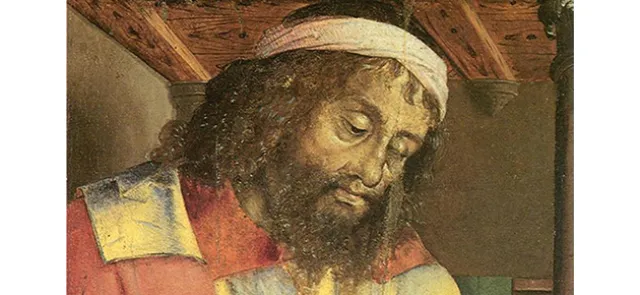
The multiplicity of infinities
Actual infinity is a mathematical fiction, useful in calculations and proofs alike. We may reject it and make do with potential infinity. But if we accept the notion of infinity, there must be more than one. Georg Cantor—him again!—proved it.

Holy paradoxes! (1): A mathematical brief | Tangente
Paradox is to logic what experiment is to the physicist: it allows us to adjust theory in response to the question posed by an alarming result. It is a springboard for the mind.
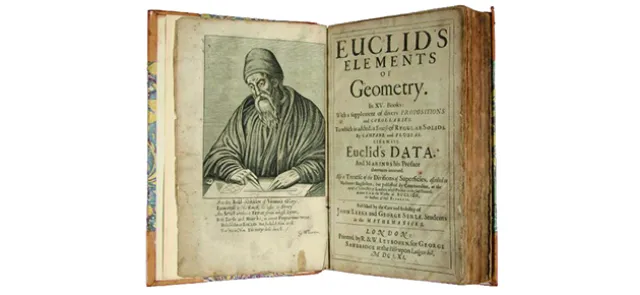
What exactly are axioms? — Geometry | Tangente
In mathematics, every proof starts from premises assumed to be true. What particular form must these premises take to become axioms, the foundation of all our current theories?
The ternary Cantor set
Cantor constructed a fractal set before fractals had a name, showing that a subset of the real line can have the cardinality of the continuum, have measure zero, and have empty interior.
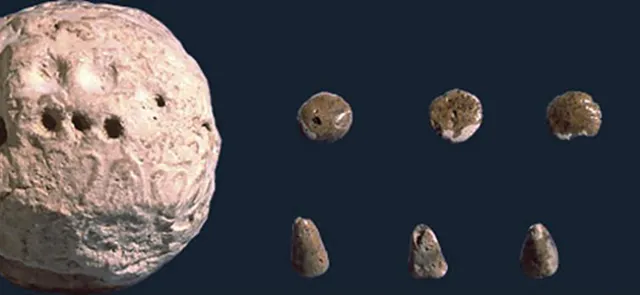
Constructing numbers: a long history
In the beginning was number... If we go back to the very origins, these objects were represented by pebbles before being encoded by symbols. In fact, there are numbers to suit every taste! As everyone knows, when you love something, you don't count the cost...
Dedekind and sets — Mathematical brief | Tangente
One of the earliest champions of set theory was the German Dedekind, who famously corresponded with Cantor.

Dazzling binary relations
All people are born free and equal in rights. Yet someone like Coluche could add, not without mischief, that "some are more equal than others"! Defining an order, or an "equality" of some kind, requires us to establish precisely what these notions mean.

Naming the elements of a set
As David Hilbert famously remarked, assigning a name to a mathematical object is artificial. Identifying an object with its image under a bijection, however, so as to bring out its properties, can be decisive.

Relations and maps: structuring sets
A notion of relation between sets is essential if we are to begin doing mathematics. At the heart of the foundations of mathematics, the concept of a relation includes maps as a special case and gives sets structure.
The rules of infinity
You cannot play with sets without abiding by certain rules...
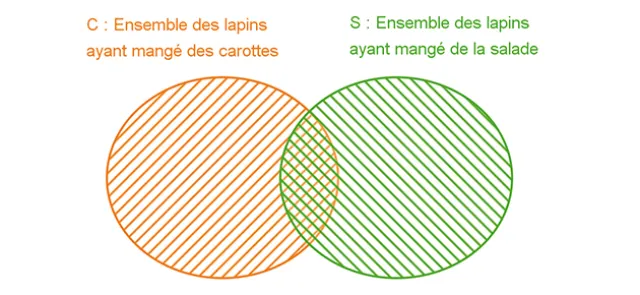
Potato diagrams: a chipper idea
When considering several subsets of the same set, it can be difficult to distinguish their various intersections. Representing these subsets as "potato-shaped blobs" often makes things clearer—and keeps us from looking like potatoes when faced with questions that are simpler than they seem.

The set and its subsets
Elementary operations on sets include inclusion, union, intersection and symmetric difference. The notion of a power set is equally natural and fruitful. How can we describe, count and structure the subsets of a set?

From a collection of objects to a set
A set can be defined extensionally or intensionally. Constructing the natural numbers then becomes an easy but instructive exercise. Yet beware the apparent simplicity of a set viewed as a mere collection of objects: paradoxes lurk...

Set and Dobble: two smash-hit games | Tangente
Here are two well-known games whose structure is based on set theory
The New Math controversy — A Tangente math brief
By the late 1960s, reform of the mathematics curriculum had become essential. The reform proposed by the Lichnerowicz Commission took the conceptual approach too far, at the expense of intuition.