A reform: why and how
---------------------------------
The reform known as New Math was devised by the Commission ministérielle d'étude pour l'enseignement des mathématiques, better known as the Lichnerowicz Commission after its chairman. From 1967 to 1973, it worked on developing new curricula. Its members included secondary-school teachers—who generally supported the reform, as did the Association des professeurs de mathématiques de l'enseignement public—and inspectors. The aim was to modernize the curriculum and introduce relatively recent concepts, particularly algebraic structures, at the expense of "old-fashioned" geometry: apart from the concept of a vector, introduced into the curriculum in the early 20th century, the body of mathematics taught in schools had long remained unchanged.
The new curricula favored absolute rigor at the expense of intuition. Triangles could no longer be called "equal," since they are in fact merely isometric, not identical. Reliance on intuition was discouraged in favor of introducing more theoretical concepts. Students were asked to construct sets of numbers rather than develop an understanding of them through experience. The concept of a group was introduced as early as the end of middle school, while preschool and primary-school teachers were encouraged to introduce pupils to the notions of unions and intersections of sets.
-
What was the outcome?
------------
Even the reform's staunchest supporters soon realized that it had gone too far. From the early 1980s onward, the curricula scaled back overly theoretical approaches, once again encouraging links with the real world and restoring mathematics to its role of modeling it. In 1983, schools returned to a more traditional approach to teaching geometry.
Yet the reform was far from entirely negative! The set-theoretic approach to mathematics remains modest but real, and a reasonable concern for rigor is still present. One may nevertheless wonder whether this counter-reform went too far, often sacrificing the teaching of proof, even though proof remains the essence of mathematics.
-
The reform's limitations and the opposition
---------------------------------------------
The aim of the reform was to give students rigorous mathematical content independent of physical reality. It was thought that this would allow them to skip the intermediate stages and directly attain an overarching view of mathematics from which all applications stem. In practice, many of them were lost without intuitive support. Furthermore, the reform was introduced at breakneck speed; teachers, particularly primary-school teachers, were poorly prepared to teach the new concepts, despite the many refresher courses offered to them.
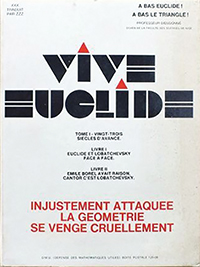
The reform therefore met with resistance and even fierce opposition. Educated parents worried that they could no longer understand what their children were learning. More seriously, many teachers, drawing on their experience with students, rebelled against the highly abstract presentation of mathematics and its lack of connection with physical reality. Associations sprang up, including the Association de défense des mathématiques utiles, while books also appeared in defense of "old-fashioned" mathematics. Two books by Georges Antoniadès Métrios enjoyed some circulation: Cantor à tort, histoire d'une lutte de deux mille trois cents ans entre deux formes de la pensée (Sival-presse, 1968) and Vive Euclide ! (DL, 1970) took the opposite stance from the famous "Down with Euclid! Down with the triangle!" attributed to Jean Dieudonné, a member of Bourbaki.