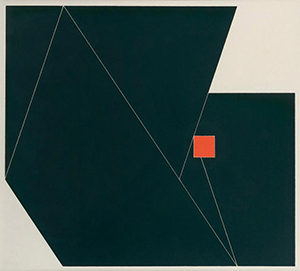
The Japanese artist, who works with compasses, rulers and set squares, was named a “Living National Treasure” in 2007, an honour granted to him for achieving excellence in his field, yuzen (the art of dyeing, which dates back to the 17th century).
“From framing to framing, squares, triangles and circles converse with one another and reveal a hidden order”, he states. And he knows what he is talking about: he himself is the author of the book Mathematical Reflections on the Purity of Spring Water (1987, Éditions Galerie Jeanne-Bucher-Jaeger), and his creations are inspired almost exclusively by geometry. While perpetuating the tradition of yuzen dyeing, he has succeeded in renewing this art and giving it patterns that op art would not disown. Another work, Thirty Studies on Green (same publisher, 1990), fully expresses the artist's affinity with the forms that fill his work, some of which could be the subject of a genuine geometry problem.
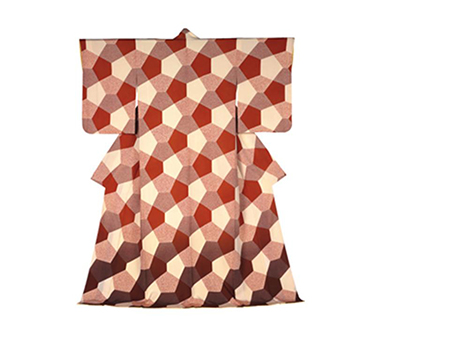
A kimono called Scarlet Pentagons