The year of the black cat, 2026 has three Friday the 13ths in store: one in February, one in March, then one in November. For some, this may be an occasion to try their luck at the lottery. In any case, superstitious folk of every stripe should make the most of it, since there can never be more Friday the 13ths in a single year.

You may still have vivid memories of 2025 which, being the square of a triangular number, held a great many particularly elegant properties and was even the subject of countless videos and various animations on social media. 2026 might seem duller at first glance, but don't be fooled — there is plenty of fun to be had this year too!
A little something extra
Unlike last year, 2026 is not a square. However, 20263 – 20262 is one (that of 91,170), which generalizes to any successor of a square. What's more, 2026 is naturally the sum of two squares (2026 = 2025 + 1), but this is in fact the only way to break it down as a sum of two nonzero squares. That is not true of every integer of the form n2 + 1.
For example, 65 = 82 + 1 = 72 + 42 and 2117 = 462 + 1 = 342 + 312. Pierre de Fermat (c. 1605–1665) took a close interest in decomposing integers as a sum of two squares, in particular in a long letter dated Christmas 1640 and addressed to "my reverend Father" Marin Mersenne (1588–1648). It would take the work of Carl Gustav Jacobi (1804–1851) in the 19th century, however, before a formula could be established giving the number of decompositions of a given integer as a sum of two squares.
Let's return to 2026 and the fact that it can be written in the form n2 + 1, and in particular that the integer n in question, namely 45, is odd. When the integers are written out in a spiral, the successors of odd squares all appear in the bottom right-hand corner.
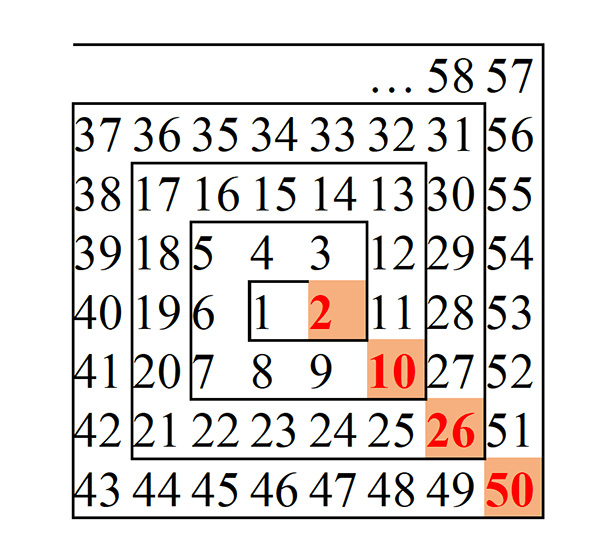
It was while attending a conference, reportedly a particularly boring one, that Stanislaw Ulam (1909–1984) doodled this spiral in 1963. In it he colored in the prime numbers and so saw fairly regular patterns emerge — patterns that, to this day, still partly retain their full mystery.
Another link exists between 2026 and numbers of the form n2 + 1. If you start from 0 and repeatedly apply the function defined by f(n) = n2 + 1, you will eventually land on a new number ending in 0. This happens after six steps, and the result is, in fact, 458,330. It also works starting from 1 or 2, but not from 3. To convince yourself, you need only run the numbers: you end up in the cycle (0, 1, 2, 5, 6, 7), which repeats indefinitely without ever returning to 3. With 2026 too, you will eventually land on a number ending in 2026, again after six steps. The number in question is:
42162622043820589475763301393483294985588850597501496703159869505429422415405447935056426521817349366932281173228027648242763557187328577506503742486145502193136631059483236263981479149047893828475561779562152026. Phew!
Furthermore, by iterating the function f on a number with 4 digits or more, you always end up with a number whose last 4 digits belong to the cycle (4330, 8901, 7802, 1205, 2026, 4677).
A plethora of arithmetic properties!
In addition to being the successor of a square, 2026 is also the predecessor of a prime number. The next time this happens will be in 3250. Note, however, that 2208 is also bracketed by a prime and a square, but not in the same order.
We saw that 2026 can be expressed in only one way as a sum of two squares, but it can also be obtained as a sum of seven cubes. There are then nine possible solutions: can you find them all?
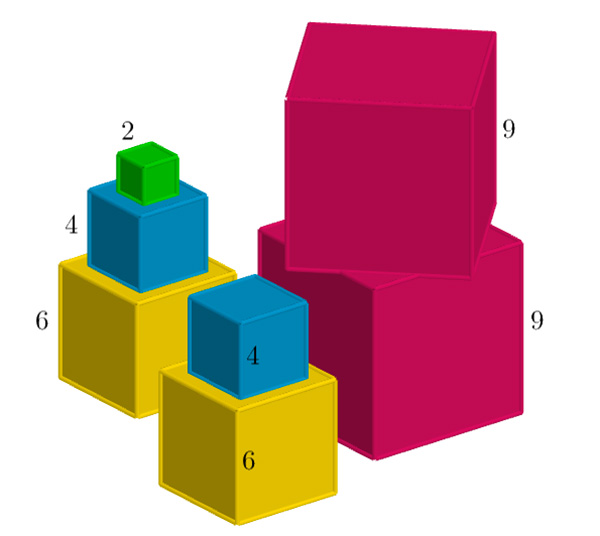
2026 is the sum of 7 cubes.
If you're keen on adding up squares, you need only choose judiciously among the first 21:
1² + 2² + 3² + 5² + 6² + 7² + 10² + 11² + 13² + 14² + 15² + 17² + 19² + 21² = 2026.
Amusingly, the ones that were removed are not just any numbers: they are the squares of 4, 8, 9, 12, 16, 18 and 20. All these integers are themselves divisible by squares. In fact, we kept only the first 14 squarefree integers, that is, integers not divisible by a perfect square (other than 1, of course). Fermat, incidentally, relied on these squarefree integers to tackle the famous problem of the Christmas theorem!
Since we're on the subject of divisibility, let's stay in the realm of arithmetic, where the sum s(n) of the proper divisors of an integer n offers a genuine playground for anyone who enjoys recreational mathematics.
For example, s(2366) = 2026, since the divisors of 2366 are 1, 2, 7, 13, 14, 26, 91, 169, 182, 338 and 1183. The calculations take a little longer by hand, but you can also check that s(s(4402)) = 2026. If, however, you're looking for an integer n such that s(s(s(n))) = 2026, you're likely to be disappointed, because none exists!
In a different vein, let's also note that 2026 = 211 – 2 × 11. This aesthetically pleasing notation has a concrete interpretation. Imagine you want to form a group of 11 people who speak either Chinese or French (but not both), with no one left speaking their language alone. There are then 2026 ways to do this: each person has two language choices (Chinese or French), giving 211 possibilities, from which we subtract the 11 situations where only one person speaks French and the 11 situations where only one speaks Chinese.
Elegant geometric arrangements
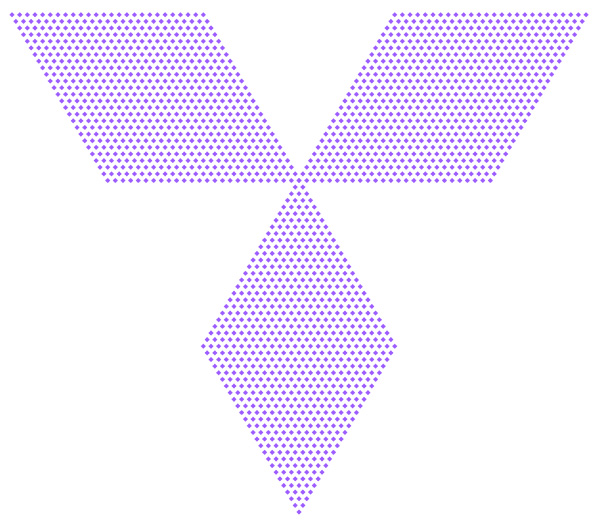
Arranging points to form particular figures was a popular activity in the time of the Pythagoreans and has attracted interest ever since. For example, you can draw "diamonds" by arranging points in the shape of a rhombus. Here, for example, are the diamonds of side 2, 3 and 4:
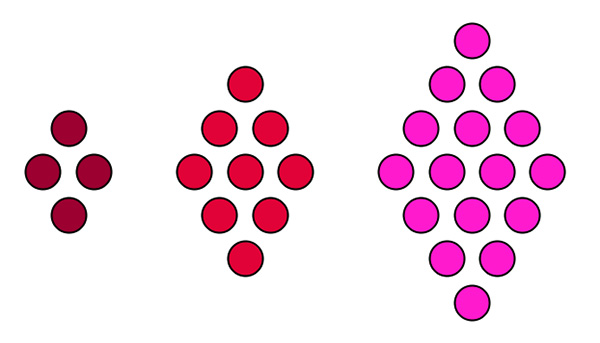
Since it's 2026, let's assemble three diamonds of side 26 at a common vertex to form an equilateral triangle, which requires… 2026 points!
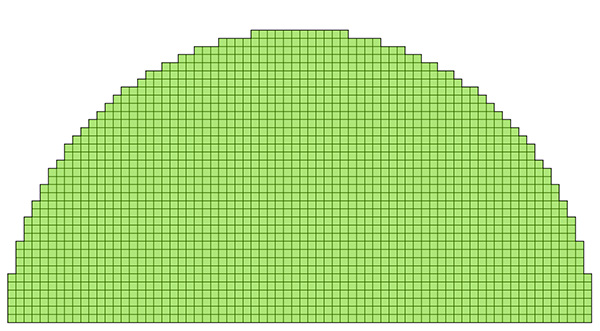
Pixelated images are made up of little squares that can also be painstakingly counted. In the half-disk below, there are exactly 2026 of them!
Graphs, too, offer particularly demanding counting questions. Consider, for example, all quartic graphs — that is, those where exactly four edges meet at each vertex — and, among those, let's keep only the ones with 17 vertices. Some of them are quite beautiful, and there are 86,223,660 in total. That's an enormous number, but if we remove all the connected ones, meaning those made up of a single piece, only 2026 remain!
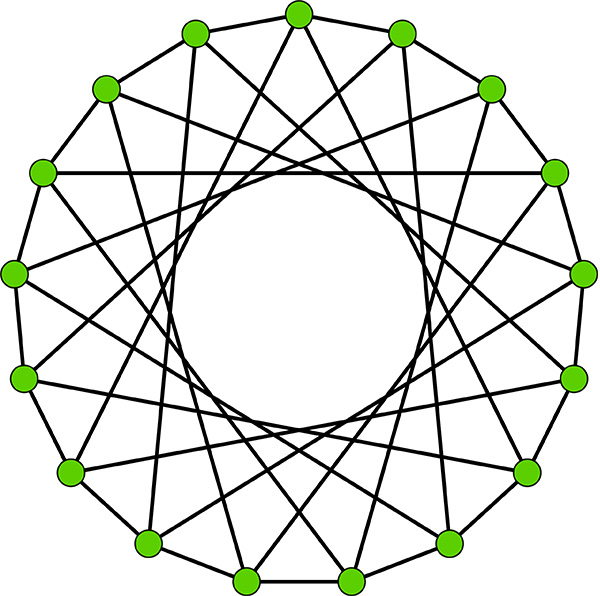
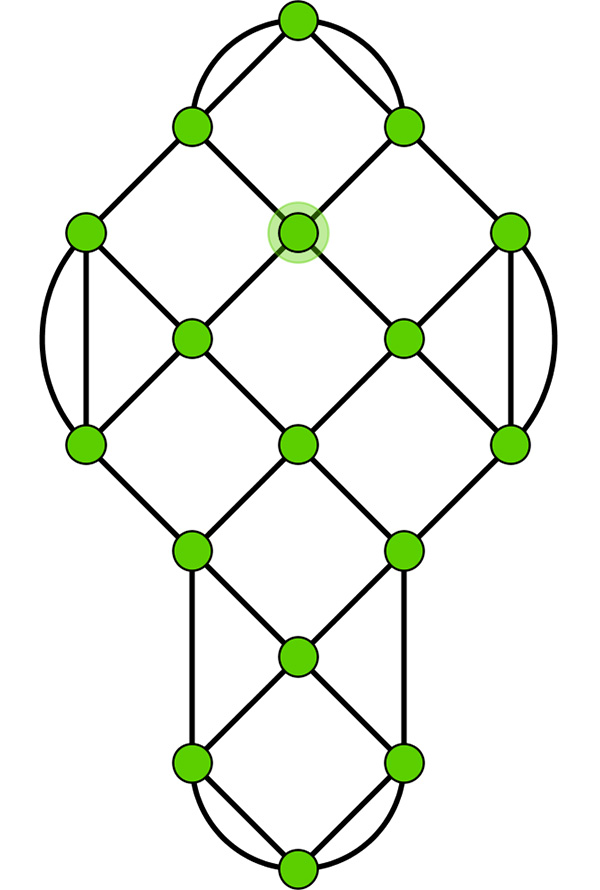
Two connected quartic graphs of order 17.
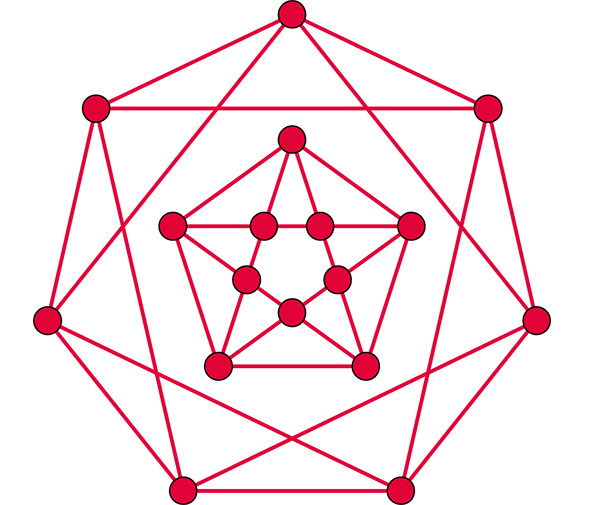
A disconnected quartic graph of order 17. There are 2026 of them.
Geometric shapes crop up throughout mathematics. Pascal's triangle is well known, but its variants somewhat less so. Yet all it takes is replacing the 1s on the sides of Pascal's triangle with other sequences of numbers to open up new territory to explore. Here, for example, is what you get by taking the sums of the integers from 1 to n as the first and last term of the n-th row, after the initial 0.
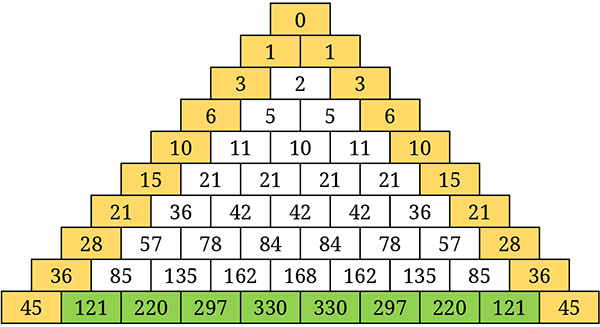
The sum of the entries in row n is 2(2n+1 – n – 2), and so for the ninth row, the sum is 2026.
To the pegs!
To wrap up this overview devoted to 2026, let's turn to the Tower of Hanoi. This famous puzzle, invented by the mischievous Édouard Lucas (1842–1891) in 1889, consists of three pegs. The first peg holds a stack of rings of decreasing size, which must be moved to the third peg following these rules: never pick up more than one ring at a time, and never place a larger ring on a smaller one. The puzzle is well known to all enthusiasts of recreational mathematics, and it takes at least 2n – 1 moves to move n rings. Beyond its solution, the puzzle holds treasures that are far from obvious at first glance. Many variants have been proposed since (see Itération et récurence (Iteration and Recursion), Bibliothèque Tangente n°76, POLE, 2021), and some questions remain open even today!
But have you heard of the "magnetic" variant invented by the Israeli Uri Levy? In this version, the rings have two faces (say, one blue, one red) that can be imagined as polarized like magnets. As in the classic game, you can only move one ring at a time, but you must also flip it before setting it down and, of course, since the rings are magnetized, you cannot let two faces of the same color touch.
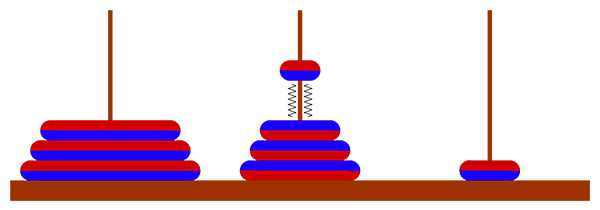
In the magnetic Tower of Hanoi, the rings must be flipped
at every move, taking the polarization into account.
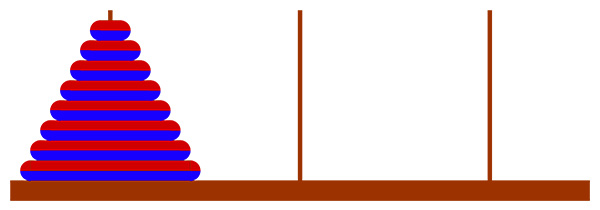
For a stack of two rings, it now takes at least 4 moves to solve the puzzle (compared with 3 for the classic game). The most common Tower of Hanoi sets have eight rings, and it then takes 255 moves to solve the puzzle. In the magnetic version, with eight rings, that jumps to 2026 moves!
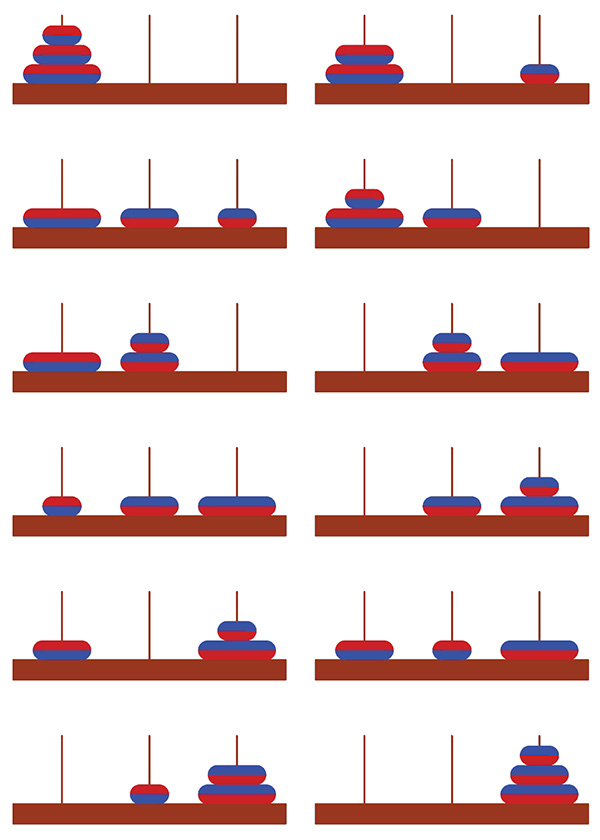
With 3 rings, at least 11 moves are needed
to solve the magnetic Tower of Hanoi.
So, who said that 2026 wouldn't be mathematically as interesting as the previous year? With this certainly non-exhaustive overview, here is plenty to prove the contrary and start the year off right!