This 1895 painting depicts a classroom in Russia at the end of the 19th century, just as its painter, Nikolai Bogdanov-Belski, had known it. He portrays his own schoolteacher, Sergei Alexandrovich Ratchinski, setting his pupils a mental-arithmetic exercise: calculate the fraction
A useful trick for solving this problem is to rewrite the numerator N in the more symmetrical form
N = (12 – 2)2 + (12 – 1)2 + 122 + (12 + 1)2 + (12 + 2)2,
and then
N = [(12 – 2)2 + (12 + 2)2] + [(12 – 1)2 + (12 + 1)2] + 122.
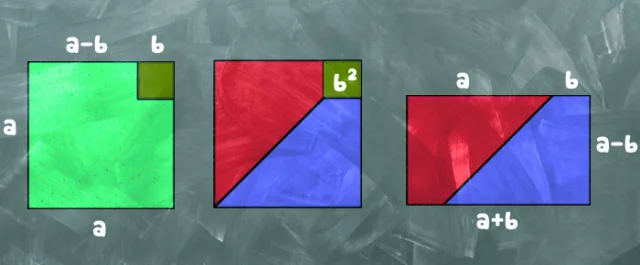
Using the identity (a + b)2 + (a – b)2 = 2(a2 + b2),
we then obtain N = 2(122 + 22) + 2(122 + 12) + 122 = 5 × 122 + 2(12 + 22) = 730,
and hence R = 2.
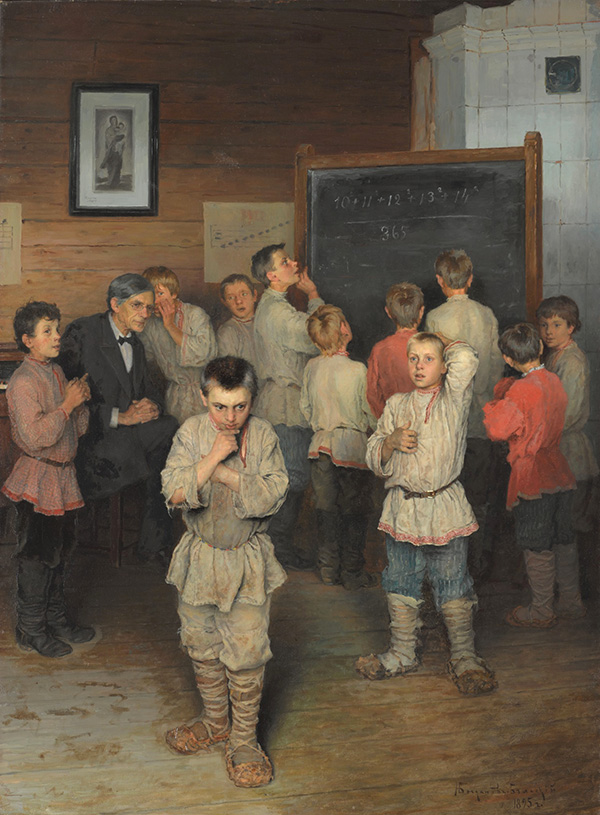
Mental arithmetic. At S. A. Ratchinski's public school,
by Nikolai Bogdanov-Belski, 1895 (Tretyakov Gallery, Moscow).
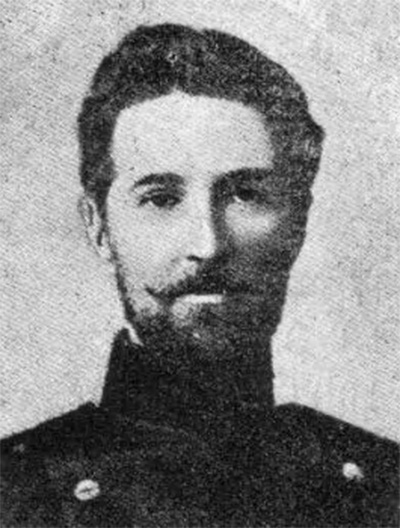
Sergei Alexandrovich Ratchinski (1833–1902)
-------------------------------------------------
In an earlier life, the schoolteacher at this rural school had been a botanist, a mathematician and Darwin's first Russian translator, before returning to his native village to establish schools there.
For fifteen years, he developed his own creative approach to teaching. Every evening, he trained his pupils in mental arithmetic by improvising problems of increasing difficulty, interspersed with easier ones to encourage "the weakest pupils". He was convinced that only his constant creativity and sustained mental effort could inspire similar intellectual effort in his pupils.
To help colleagues in rural schools who, because of a "lack of familiarity with numbers", were less inclined to devise arithmetic problems, he published 1,001 Mental Arithmetic Problems in 1899. The book included everyday problems he had set his pupils, involving conversions between units of length, area and mass, and the cost of buying everyday products—including tobacco and vodka, which gave him an opportunity to warn the children about the dangers of consuming them at too young an age. He did not overstate the merits of mental arithmetic, but regarded it as both a practically useful activity and a healthy intellectual exercise.
Ratchinski's sequences
-------------------------------
For Ratchinski, a simple yet thorough knowledge of the first thousand numbers was an inexhaustible source of problems.
Pupils were therefore expected to know that 365 = 5 × 73, but also that 365 = 5 × (80 + 81 + 82 ),
and that 102 + 112 + 122 = 132 + 142 = (172 + 212)/2.
These relations are special cases of sequences he discovered while investigating regularities in sums of squares.
For a given integer k, choose *nk = 2k(k + 1) so that the sum Σk of nk*2 and the squares of the k numbers preceding it equals the sum of the squares of the k numbers following it. Moreover, the number *nk is then four times the triangular number Tk (the sum of the first k integers, which is also equal to k(k* + 1)/2).
We can also prove the identity Σ*k* = σ2(24 σ1 + 1), where σ*p is the sum of the pth powers of the numbers from 1 to k*.
A pupil who knew these properties could instantly give the answer to the problem on the board, which corresponds to the case k = 2.