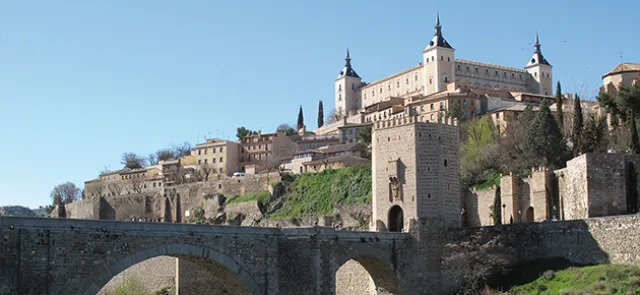
Little is known about Adelard's life. He was born near Wells around 1080, some fifteen years after William the Conqueror's conquest of England. He lived in Bath, in south-west England, but traveled to Tours to further his education before teaching in Laon. He traveled extensively: first to Sicily, where he encountered Greek culture; then, following in the wake of the Crusades, he stayed in Tarsus in Cilicia and in Antioch. He returned to the West in 1126 and died in 1152.
Adelard wrote two seminal works. In De eodem et diverso ("On the Same and the Different"), written around 1110, he explored the nature of things, including everyday problems solved through geometry. In Questiones naturales, written as a dialogue, he explained to his nephew the causes of numerous physical and moral phenomena.
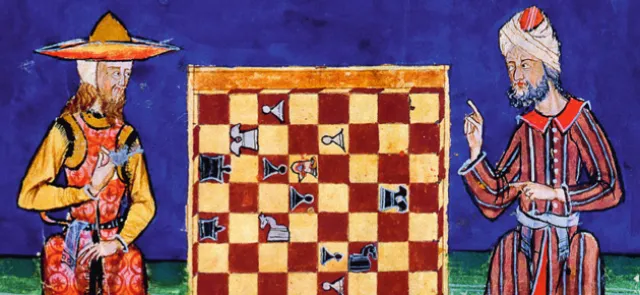
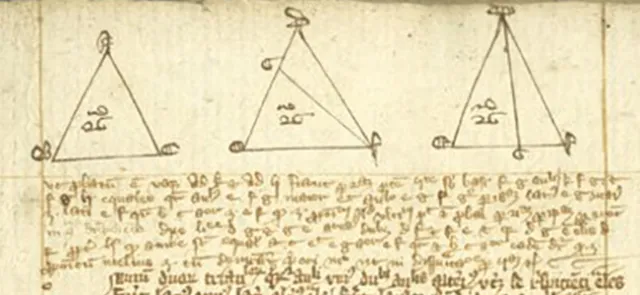
During his stays in the East, Adelard learned Arabic. He then translated al-Khwarizmi's astronomical tables into Latin, along with an Arabic version of Euclid's Elements. His many other translations of scientific texts from Arabic gave the West access to new knowledge. Above all, he passed on the advice of his Arab "masters": be guided by reason, not by arguments from authority. This outlook, new to the medieval West, would take three centuries to flourish, ultimately giving rise to the scientific spirit during the Renaissance.
A translator of Euclid into Latin
--------------------------------
The mathematician al-Hajjaj ibn Yusuf ibn Matar worked in Baghdad; he produced the first Arabic translation of Euclid's Elements, dedicating it to Caliph Harun al-Rashid, who reigned from 786 to 809. He based it on a Greek version brought from Constantinople. Dissatisfied with his text, he produced a second translation in honor of Caliph al-Mamun, who had succeeded his father. Half a century later, Ishaq ibn Hunayn produced a new translation of the Elements, followed shortly afterward by one from the celebrated mathematician Thabit ibn Qurra.