When a humorist talks to us about mathematics
---------------------------------------
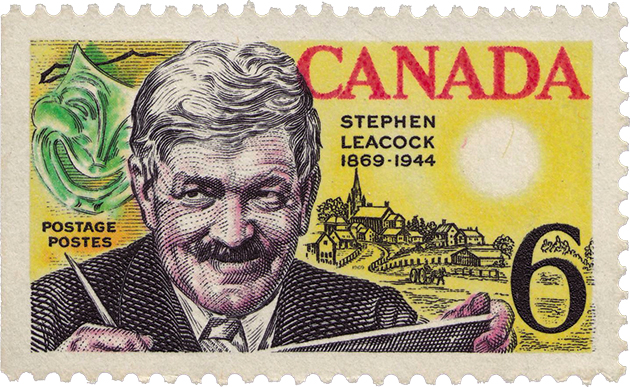
Stephen Leacock (1869–1944), a Canadian writer born in England and a humorist in his spare time, left us numerous novels and short stories, some of which have been translated into French, such as Ne perdez pas le fil (Literary Lapses, 10-18, 1981) or le Plombier kidnappé (excerpts from Nonsense Novels, Le Dilettante, 2005), each more outlandish than the last. What interests us here is when his stories touch on mathematics, full of comic absurdity…
The axioms of a good boarding house
--------------------------------------------
Leacock devises his own axioms in Géométrie de pension de famille, one of the short stories in Ne perdez pas le fil:
"- Definitions and axioms:
All boarding houses are of the same type.
All lodgers on the same floor of the same boarding house are equal.
The landlady of a boarding house is a parallelogram, that is to say an oblong and angular figure, indescribable yet resembling nothing at all.
Postulates and propositions:
The landlady can be reduced to her simplest form by a series of propositions.
The bedsheets of a boarding house, however far extended on both sides, never meet.
If a line is drawn between the two opposite ends of a boarding house passing through every room, then the stovepipe that heats the lodgers will lie within this line."
-
Treating serious mathematics with a laugh
-------------------------------------------
Aware of how ridiculous some of his characters are, Leacock also knows how to poke fun at their pedantic yet wildly inaccurate side in la Force des statistiques:
"I've just been reading some very interesting statistics, said one.
– Ah, statistics, said the other, a marvelous thing, sir, statistics.
*– For example, I found, said the first, that a drop of water is made up of little… little… I've forgotten what, but every cm3 contains… tell me…*
– Let's say a million, said the other, encouragingly.
– Yes, a million or perhaps even a billion, well, a lot, anyway!"
In Éducation aristocratique, Leacock lambasts the practices of a fussy democracy:
"House of Lords, 25 January 1920. Today we are debating clause No. 52,000 of the Education Act, dealing with the teaching of geometry in schools. […] the head of Government proposes a clause worded as follows: 'The base angles of an isosceles triangle are equal, and if the equal sides of the triangle are extended, the exterior angles are also equal.' […]
The Archbishop of Canterbury is against it, deeming the statement too 'secular'. He proposes 'the base angles of an isosceles triangle are, in every Christian community, equal, and if a member of the Christian congregation extends them, the exterior angles are equal.' […]
Lord Halifax goes so far as to propose an additional amendment: 'The angles are equal two days a week, except in schools where 4/5 of the parents conscientiously object to the use of isosceles triangles.'"
In another short story, ABC, l'élément humain dans les maths, Leacock mocks the phrasing of so-called "concrete" problem statements:
"The characters of the problem are A, B and C. The question is usually phrased like this: 'A, B and C do a certain job. A can do as much in one hour as B in two hours, and B works twice as fast as C. Find how long…' Or else: 'A bets that he can walk faster than B or C. A can walk one and a half times as fast as B, and C is just an average walker. Find how far they will go.' […] Their occupations grow ever more specific. Sometimes they prefer to fill water tanks by pumping, two of which have holes in the bottom, the third being watertight. A, of course, has the good one; he is also the one with the best bike, the best locomotive, and the right to swim with the current. […] In the old arithmetic chapters, the characters are named John, William and Henry, and argue over how to share their marbles. In algebra, they are often called X, Y, Z, but these are only their first names; in reality, they are the same people."