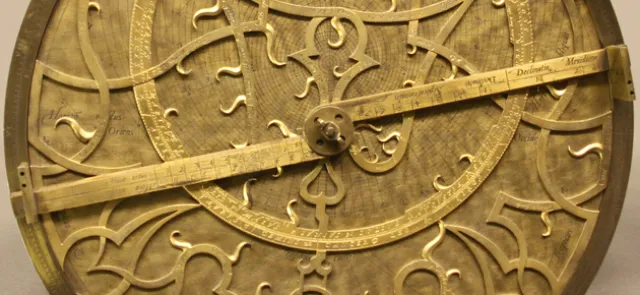
The fraction 2/5 and Thales' theorem are, in a sense, mathematical objects. But here we are interested in concrete, tangible, physical objects. Historically, the first were instruments. They were tools for measuring, drawing, building or calculating. Beyond their purely practical purpose, studying them as objects gives us insight into the evolution of scientific thought. Instruments were created to solve problems. They embody the knowledge of their time and the approach taken by their designers. Some enhance human performance (greater precision, greater speed...), while others make it possible to overcome impossibilities. Sighting instruments, for example, measure inaccessible distances. By comparing instruments from the same family, we uncover the mathematical knowledge built into them. The more practical they are to use, the more sophisticated they are.
Giving concepts physical form
=============================
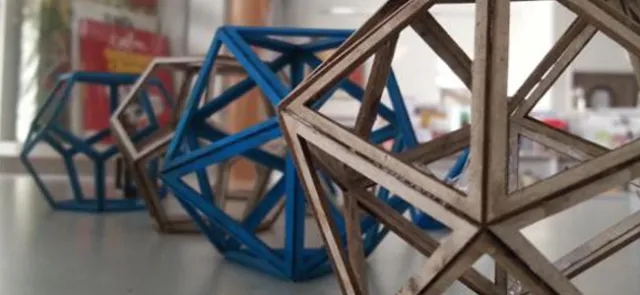
Mathematics deals with abstract objects. A line or a plane is a "mathematical object" that does not exist in the real world. A polyhedron is defined by its structure and properties. Giving an abstract object physical form—even as only a crude approximation of an intellectual conception—allows us to experience it through our other senses: we can see it, touch it, manipulate it, rotate it and admire its structural symmetries. It becomes the embodiment of an idea.
Objects, and even machines, were already in use in ancient Greece. Greek mathematicians were in touch with the real world and drew on material considerations. Archimedes was an engineer, Hero of Alexandria a mechanic... Euclidean geometry is straightedge-and-compass geometry.
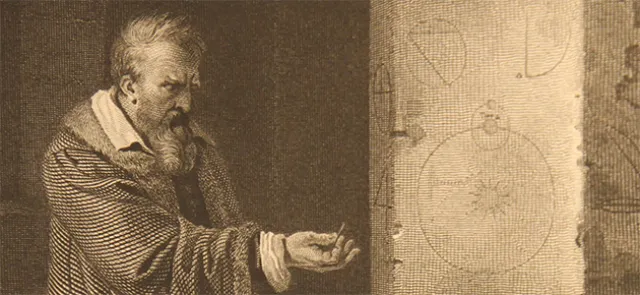
During the Renaissance, Leonardo da Vinci is thought to have drawn his marvelous polyhedra from physical models. A study of Johannes Kepler's correspondence has shown that he too used physical models of polyhedra. Cabinets of curiosities have always contained mathematical objects!
Another way to engage with the concept is to make it and give it physical form. The challenge is to reconcile the object with real-world constraints—the available materials, the tools required and so on. It is then defined by a sequence of operations and technical specifications explaining how to create it from nothing. The object thus acquires two identities: one in the world of ideas and one in the real world. Indeed, modern humans are thought to have grown more intelligent through... knapping stone.
Many artists explore mathematical concepts through the creative process; mathematicians use this mirror of reality to develop intuitions. The exchange also runs in the opposite direction. The Greeks, for instance, used objects to gain access to theories that eluded them. Nicomedes' machine, designed to solve the problems of trisecting an angle and doubling a cube's volume, is one example. The object led to the discovery of conchoid curves.
The armillary sphere makes it possible to do spherical trigonometry without trigonometry; regular polyhedra undoubtedly originated in crystals observed in nature... Today, computer simulation contributes to this back-and-forth exchange.