**The ruler and its history**
=========================================================================
The oldest surviving measuring rod is a copper-alloy bar dating from 2650 BCE (Nippur, in present-day Iraq). Other rulers, made of ivory, were used by the Indus Valley civilization before 1500 BCE.
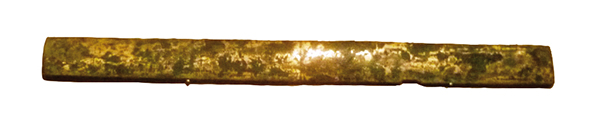
A gilded bronze ruler 23.1 cm long was discovered in the Chinese city of Hanzhong. It dates to between 206 BCE and AD 8 and is on display at the Shaanxi History Museum (Xi'an).
The folding rule was invented by German industrialist and inventor Anton Ullrich in 1851. The flexible ruler was devised by American Frank Hunt in 1902; it is on display at the Smithsonian National Museum of American History (Washington). Made of steel and 45.6 cm long, it was designed for drawing straight lines on curved surfaces, such as those of large books. The ruler was not graduated, but it had a small, round metal handle in the middle of its visible face. Nine rectangular clips on the back held several layers of paper covered by a rectangular metal plate.