Suppose you are given a sequence beginning 2, 4, 132, 2,192, 16,390, 78,132, 279,944,
823,552, 2,097,162, 4,782,980. How can you find the next term? The trick is to take the difference between each pair of consecutive terms, then repeat the process with the new numbers obtained. We stop as soon as a row contains only a single term (here, row 7, which consists solely of the term 5,040). From this, we infer that the sequence gives the values of a polynomial of degree 7.
Now, how do we find the next term?
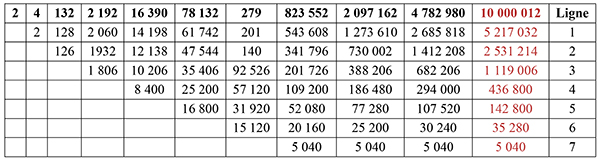
Each term is obtained by taking the difference between the term
directly above it and the one above and to its left.
The red column is filled in from bottom to top, starting
with 5,040 and continuing until the desired number, 10,000,012, is reached.
We simply propagate the differences:
35,280 = 30,240 + 5,040,
then 142,800 = 107,520 + 35,280,
then 436,800 = 294,000 + 142,800,
then 1,119,006 = 682,206 + 436,800,
then 2,531,214 = 1,412,208 + 1,119,006,
then 5,217,032 = 2,685,818 + 2,531,214,
and finally 10,000,012 = 4,782,980 + 5,217,032.
Completing the table requires addition alone, despite the polynomial's high degree: this is the finite difference method. These observations would inspire Charles Babbage (1791–1871) to devise the Difference Engine.