Zero has not always existed, and its introduction was revolutionary. Its emergence is generally traced back to Brahmagupta and his work Brāhma Sphuṭa Siddhānta (literally, "The Correctly Established Doctrine of Brahma"), dated AD 628. Gradually, zero enabled or accompanied many revolutions: the transition from arithmetic to algebra, the development of the method of exhaustion into infinitesimal calculus...
Doing mathematics without zero
------------------------------
Yet the fact that zero has not always existed shows that it is not strictly necessary for doing mathematics. The familiar Roman numeral system has no zero, nor do the Greek numeral system (which uses the Greek alphabet), the Egyptian numeral system, or the Babylonian numeral system.
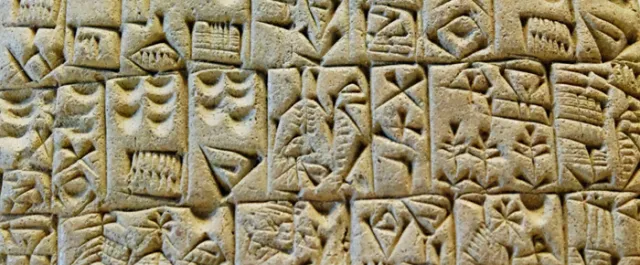
In the latter, for example—a system shaped by the constraints of cuneiform writing—units were represented by wedges and tens by chevrons. It is a positional numeral system, like ours, with one difference: it is not purely decimal, but partly decimal (the units range from 1 to 9) and partly sexagesimal (the tens range from 10 to 50).
Thus, the number 59 was written