
Perspective can produce some remarkable illusions for the observer. In the realm of perception, at least four types of perspective illusion can be distinguished: trompe-l'œil, forced perspective, anamorphosis, and a fourth, mirror-based perceptual illusion that plays on the formal ambiguity between an object and its reflection. All these illusions have one thing in common: they depend on the observer viewing them from a particular angle. Without that specific viewpoint, the illusion fades or disappears. This is the type of illusion we explore here.
Our minds are trapped!
--------------------
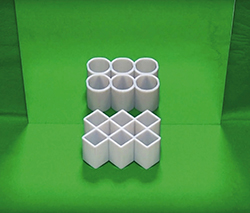
Ambiguous Cylinder Illusion, 2016.
The image opposite shows a novel illusion that took second place in the year's most fascinating and bewildering competition, the Best Illusion Of The Year 2016. Held in the United States since 2005, the competition honors the most compelling optical illusions created by artists and researchers around the world. This illusion, created by Japan's Kokichi Sugihara, certainly lives up to its name, Ambiguous Cylinder Illusion: the unusual little tubular shapes with square cross-sections mysteriously appear cylindrical when viewed in a mirror. When the presenter rotates these little shapes before our very eyes, they suddenly appear to have circular cross-sections, while their reflections in the mirror become rhomboids!
As with any self-respecting optical illusion, we see something that our mind tends to interpret… The fact that the image in the mirror does not correspond at all to the original image is very bewildering.
You can recreate this illusion at home using simple materials, such as the cardboard tube from a roll of toilet paper. The following figure shows the four steps for making your own "squircle" (or squircle in English):
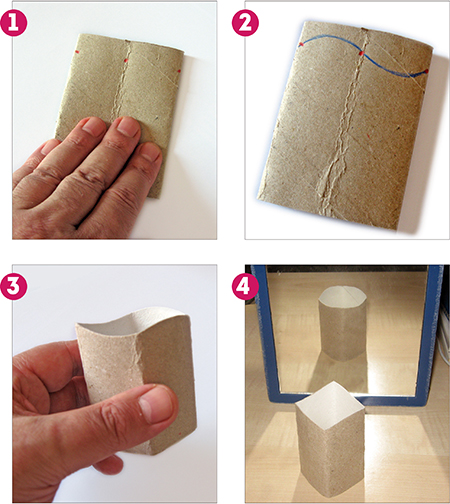
1\. Gently squash the tube twice in perpendicular directions, then mark three collinear points on one side.
2\. Using the three points as guides, draw a wavy line, then cut the tube along it. The most mathematically inclined will work out the optimal sine curve for the tube's upper edge.
3\. This gives you a shape with curved edges, halfway between a rhomboid and a hollow cylinder.
4\. Finally, place the shape in front of a small mirror and position it so that the illusion takes shape (quite literally!). The brain then tends to resolve the shape's ambiguity, assigning it to one category or the other depending on the viewer's vantage point.
And here is the animation:
You can also discuss this geometric illusion on Facebook. You can also find a striking variation at Archimedes Laboratory .
-
A researcher like no other
---------------------------------

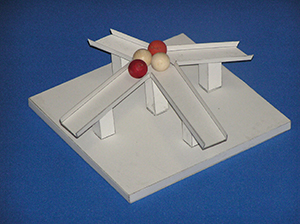
Kokichi Sugihara, a specialist in mathematical engineering, is an expert in this type of illusion. He is also interested in gravity, concavity and convexity. In Magnet-Like Slopes, the impression—reinforced by videos available online—is that the balls are rolling "up" toward the top of the structure, when in fact they are rolling downhill toward it under gravity alone!
This installation earned him the 2010 Best Illusion of the Year award.
Magnet-Like Slopes, 2010. Ambiguous Garage Roof, 2015.

Sugihara's latest creation is called Ambiguous Garage Roof, and it is particularly spectacular! We are still a long way from unraveling all the mysteries of how our brains work.
---