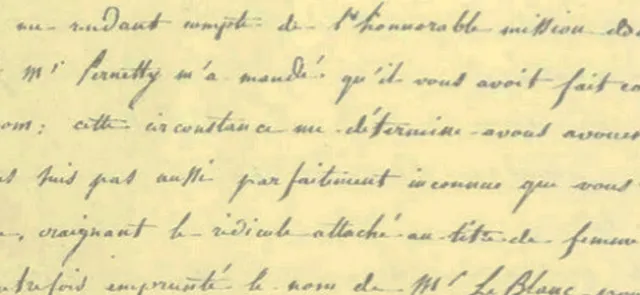
In 1924, girls' secondary schools were authorized to offer the same curriculum as boys' secondary schools, officially allowing girls to prepare for the baccalauréat there (see the article "One hundred years ago, equal access to the baccalauréat " in Tangente No. 222). Before then, under the Camille Sée Law of 1880, young women completed their education in separate secondary schools that gave them no access to higher education. Between these two dates, some pressed ahead regardless and became astronomers. For them, it all began in 1907.
Training to become an astronomer
Before 1907, entry into the ranks of astronomers was opaque, to say the least. It favored inherited privilege, family networks and men. The result was a few disappointments: young men, generally graduates of the Grandes Écoles, refused to follow the rules or carry out duties they found too repetitive. A decree therefore made a two-year traineeship compulsory, to ensure that applicants had the necessary qualities.
In 1908, Edmée Chandon (1885–1944) was admitted to this traineeship. She had a degree in mathematical sciences (1906) and came first in the agrégation examination in mathematics in 1908.
Like her male colleagues, she learned every aspect of the Observatory's operation: the daily use of meridian telescopes to check the time by observing a star's transit, the distribution of time signals within the Observatory and throughout France, notably via the Eiffel Tower, and more occasional observations with equatorial instruments. When the weather prevented observations, the entire staff carried out the data reduction* needed to publish the results.