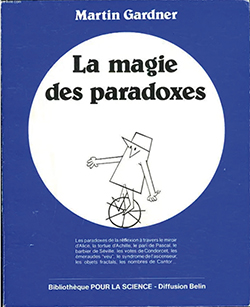
Martin Gardner was one of the 20th century's most celebrated popularizers of mathematics. He died in 2010 at the age of 95 (see Tangente 136, 2010), having invented or popularized countless puzzles, some of which are still debated today. In his book la Magie des paradoxes (The Magic of Paradoxes), published in 1980 in the Bibliothèque Pour La Science, he presents more than eighty problems, varying in difficulty but invariably paradoxical.
One particularly baffling example is an adaptation of Maurice Kraitchik's 1930 two-necktie problem. At the end of his brief analysis, Martin Gardner invites readers to respond: "If you or one of your friends can find a way to explain why the players' reasoning is wrong, without delving too deeply into the arcana of game theory, write to us. We will publish the explanation in the next edition of this book."