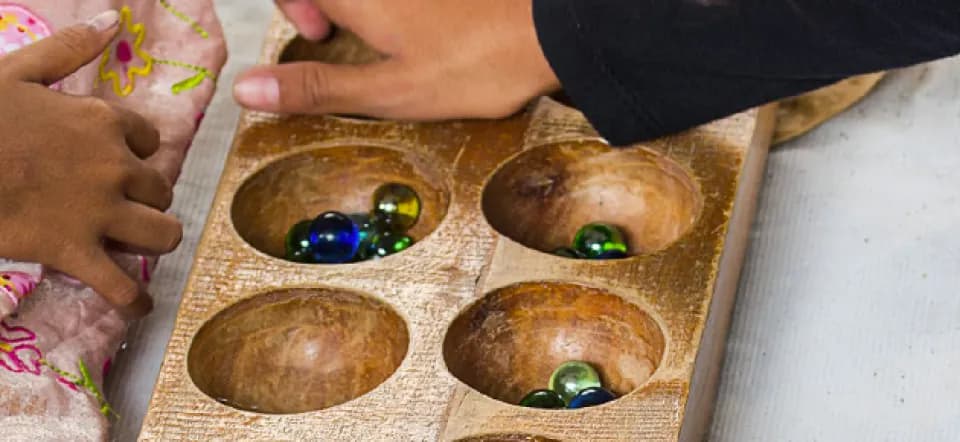
Sowing games are found the world over and come in several hundred varieties. They can vary in the number of rows of holes or cups into which seeds, pips, pebbles or shells are distributed, but they are all games of combinatorial strategy. It is customary to speak of holes and seeds. In these games, the best known of which in France is awélé, the two players take turns sowing seeds into the holes according to a precise rule. The mathematician Édouard Lucas (1842‒1891), a specialist in mathematical recreations, is credited with devising a solitaire version, Tchuka Rouma, with numerous mathematical properties.
The basics of the game
----------------
Tchuka rouma is played with a row, or sillon, of an arbitrary number of holes and a "storehouse" called the rouma at one end. Each hole initially contains an equal number of seeds. The player takes all the seeds from one hole and sows them, one by one, into the following holes, moving toward the rouma. If the last seed falls into the rouma, play continues; if it lands in a non-empty hole, play resumes from that hole; the player loses if it lands in an empty hole. The goal is to gather the greatest number of seeds in the rouma.
Tchoukaillon is a variant of Tchuka rouma, created in 1977 by mathematician Véronique Gautheron. In this game, the last seed distributed on each move must land in the rouma. Victory is achieved if all the seeds can be put into the rouma.
According to the rules, to avoid losing immediately, a player may only choose a hole whose number of seeds matches its position relative to the rouma. Such a hole is then said to be harvestable. Writing t(n) as the vector giving a winning arrangement for n seeds, a hole is thus harvestable if *tk(n) = k*.