Wavelets in the service of medicine
-----------------------------------------
The term "wavelet" first appeared in mathematics in 1984. Even though he did not coin the name, mathematician Yves Meyer was the driving force behind the development of this new theory. Mathematically, a wavelet is a square-integrable function on the set R of real numbers. Just as Fourier theory lets us expand a periodic function as a sum of trigonometric functions, a wavelet can be expanded in terms of elements from a particular family of wavelets.
For a quarter of a century, this theory has led to enormous progress in imaging, and has been used in particular in the medical field since 1992. As Valérie Perrier of the Laboratoire de Modélisation et Calcul at IMAG, Institut National Polytechnique de Grenoble, explains, "In this context, wavelets are used for compression and denoising, but also for the functional analysis of medical data (with a view to establishing a diagnosis), local tomography, image segmentation and enhancement, or indeed the description of textures".
Coordinate system for neurosurgery
------------------------------------------
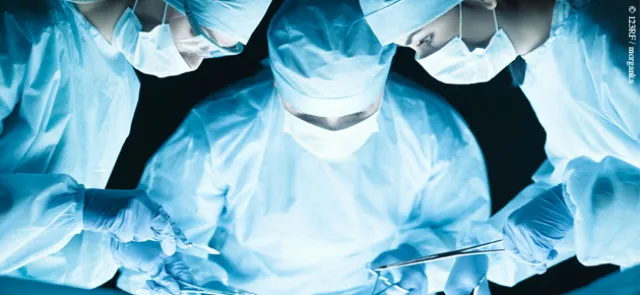
Stereotaxy devices are used in neurosurgery to reach very specific regions of the brain. In particular, they make it possible to treat areas less invasively than traditional methods. Using data gathered through medical imaging, the exact position of the target point is located in the patient. This must be done with extreme precision, since an error of just one millimeter could be harmful, if not fatal. Knowing the exact coordinates of this point relative to the patient's body, the device must then be given the precise coordinates of this point in its own coordinate system. For the mathematician, this simply amounts to a change of coordinates. Naturally, the parameters of the various rotations or translations to be carried out are programmed in to allow for the greatest possible precision.