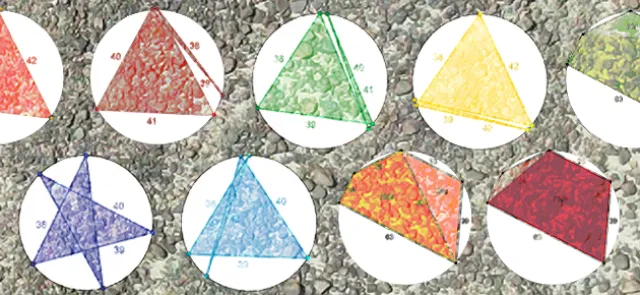
In an article in The American Mathematical Monthly, available online, Norman J. Wildberger and Dean Rubine develop a new strategy that overcomes the problems caused by the radical-based approach. The basic idea is to use the Catalan numbers *Cn, which count the ways of dividing a convex polygon with n + 2 sides into n* triangles.
It turns out that the series
satisfies the quadratic relation c(x) = 1 + xc(x)2. To generalize this, we can calculate the "hyper-Catalan numbers": for example, C[2,0,1] counts the dissections of a hexagon into 2 triangles, 0 quadrilaterals and 1 pentagon, and you can check that it equals 28. By constructing an algebra on polygon dissections and then deriving series from it, the authors manage to propose formulas for solving polynomial equations. They examine a few historical examples, including some equations that are not solvable by radicals. Their combinatorial method even opens up new avenues for research, particularly through the study of a still-mysterious array of numbers they have nicknamed "the geode." In short, forget radicals and dive into series!